
Estimated reading time: 9 minutes
For transformation leaders who are tired of watching the same decision come back with a new name.
Transformation decisions keep reopening when governance does not create real closure. The issue is rarely that people are lazy, political, or unable to align. More often, the decision was never made in a way the system could trust. The owner was unclear. The criteria were vague. The implications were not understood. The escalation path was missing. Or the decision was made in a meeting but never translated into a rule, backlog item, budget choice, process change, or operating commitment. A decision is not closed because someone said “approved.” It is closed when people know what changed, who owns the consequence, what is no longer open for debate, and when it can legitimately be revisited.
“Decision latency is the gap between saying yes and the organization acting like yes means yes.”
Michel Paquin
Table of contents
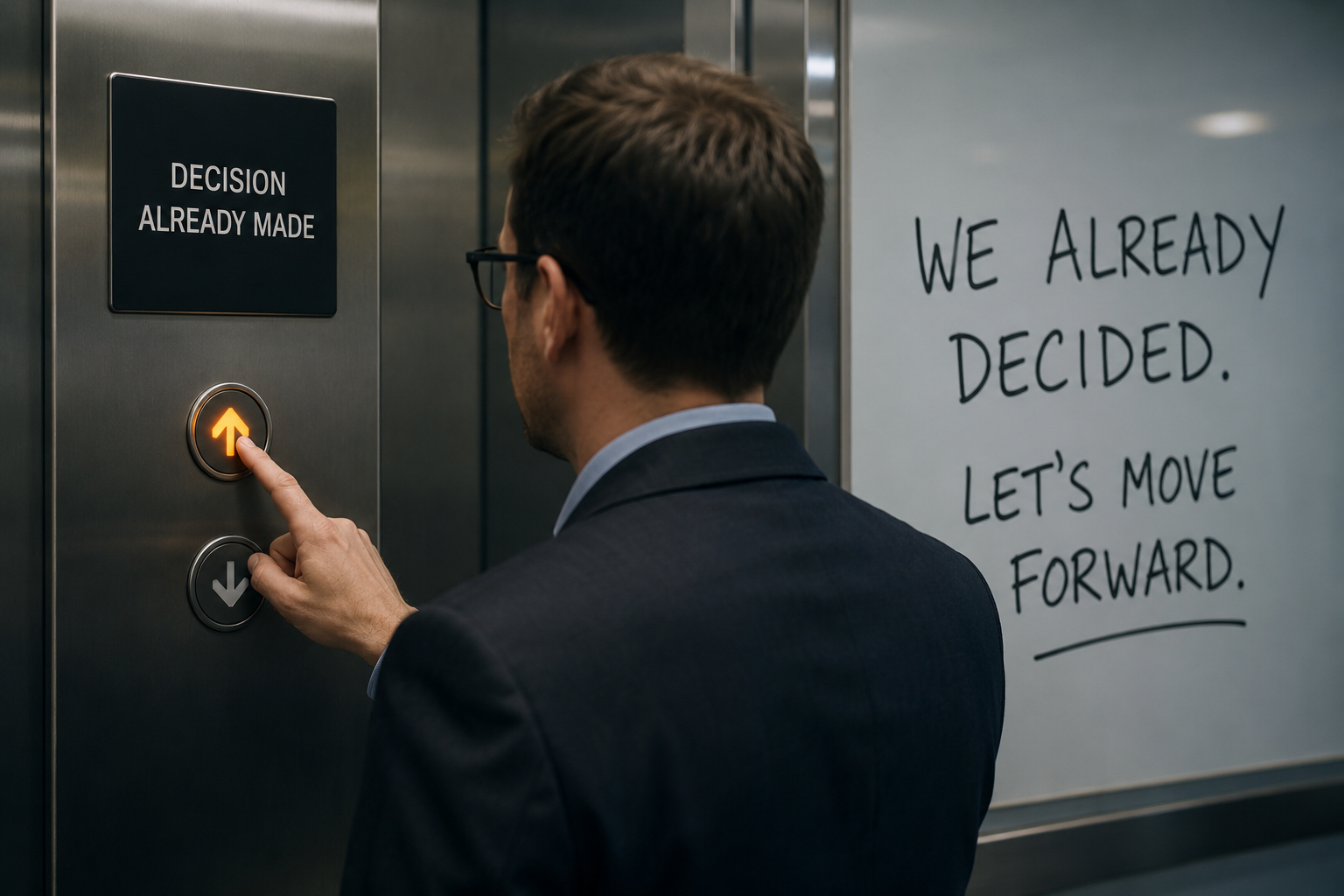
- The elevator button was already lit
- We repeat actions (decision) when the system gives us no confidence
- A decision is not closed when the meeting ends
- The hidden mechanism is decision latency
- This is not an alignment problem
- The decision closure test
- When this does not apply
- The real leadership move
- What to do this week
- Facts that matter
- FAQ
- Executive takeaways
The elevator button was already lit
I was waiting for an elevator a few days ago.
Nothing dramatic.
Just one of those quiet moments where people stand close enough to share the same problem, but not close enough to talk about it.
The button was already lit.
Then someone walked up and pressed it again.
A few seconds later, another person did the same thing.
Then a third.
Nobody was being irrational. Nobody thought the elevator would come faster because of their unique finger pressure.
But when nothing seems to be happening, we want to do something.
So we press again.
Every time I see that, I think about transformation decisions.
Not the big speeches. Not the strategy decks. Not the launch events.
I think about that decision everyone believed was already made, until it quietly came back.
Same issue.
New meeting.
Different title.
Fresh pre-read.
Same elevator button.
We repeat actions (decision) when the system gives us no confidence
The interesting part is not the button.
It is the doubt.
The light is on, but the elevator is not there.
So people start wondering.
Did it register?
Is this elevator working?
Should I press the other button?
Should I take the stairs?
Should I complain to someone?
That is what happens inside organizations too.
A decision gets made, but the system gives people no confidence that it has actually registered.
The steering committee says yes.
The project team hears maybe.
Finance hears “subject to validation.”
Operations hears “not until capacity is confirmed.”
Sales hears “we will revisit after the pilot.”
Technology hears “approved, but not prioritized.”
Everyone leaves the room with a slightly different version of the decision.
And because the decision was not properly closed, it starts moving backward.
Not because people are difficult.
Because the system left room for doubt.
A decision is not closed when the meeting ends
This is one of the quiet killers of transformation.
Leaders often think the decision happened at the moment of approval.
The team knows better.
The real test comes after.
Can the team act without asking again?
Can trade-offs be made using the decision?
Can scope be cut using the decision?
Can someone say no using the decision?
Can the backlog change because of the decision?
Can budget, capacity, sequencing, and ownership move because of the decision?
If not, the decision was not closed.
It was announced.
There is a difference.
In transformation, announcements create motion for a few days. Closure creates execution.
The hidden mechanism is decision latency
When decisions keep coming back, the visible symptom is usually frustration.
People say things like:
“We already decided this.”
“Why are we discussing this again?”
“Who reopened this?”
“Why can’t the team just move?”
But underneath, the mechanism is often decision latency.
Decision latency is the delay between saying a decision has been made and the organization behaving as if it has been made.
That delay can be short.
It can also last weeks.
Sometimes months.
And during that delay, work becomes expensive.
Teams hedge. Leaders re-explain. Analysts rebuild options. Product owners keep alternate scenarios alive. Finance asks for another model. Operations protects itself. Technology waits for clearer prioritization.
Nobody wants to be the person who acted too soon on a decision that later turned out to be softer than it sounded.
So everyone presses the elevator button again.
This is not an alignment problem
A lot of reopened decisions get mislabeled as alignment issues.
I am careful with that word.
“Alignment” can become a soft blanket we throw over harder problems.
Sometimes people are aligned enough. They understand the direction. They agree with the intent. They even want the same outcome.
What they do not have is closure.
Closure needs more than agreement.
It needs a few hard edges.
Who owns the decision?
What criteria were used?
What trade-off was accepted?
What option is now off the table?
What changes in the backlog or operating model?
Who can reopen it, and under what conditions?
Without those edges, alignment stays emotional.
People feel good in the meeting, then hesitate in execution.
That hesitation is not weakness. It is often a rational response to vague governance.
The decision closure test
Here is a simple test I like.
After an important transformation decision, ask five questions before everyone leaves the room.
1. What exactly did we decide?
Not the theme.
Not the direction.
The decision.
Bad version: “We agreed to improve the customer experience.”
Better version: “We agreed to prioritize account-based pricing visibility in the portal before self-serve returns.”
A decision should be concrete enough that someone can change work based on it.
2. Who owns the consequence?
Every decision creates a consequence somewhere.
Cost.
Margin.
Risk.
Capacity.
Customer impact.
Operational complexity.
If nobody owns the consequence, the decision will come back as soon as the consequence appears.
This is where many transformation decisions fail.
The decision is approved collectively, but the consequence lands individually.
That is when people protect themselves.
3. What is no longer open?
This is the uncomfortable question.
But it is necessary.
If everything remains open, nothing was decided.
A real decision closes some doors.
Not forever. But for now.
It should be clear which options are parked, rejected, delayed, or delegated.
Otherwise, the organization keeps spending energy on paths it no longer intends to take.
4. What must change next?
A closed decision should create visible movement.
A backlog item changes.
A funding line moves.
A policy is updated.
A process owner gets a new responsibility.
A team stops working on one thing and starts working on another.
If the decision does not change the work, it will be treated as a conversation.
5. What would justify reopening it?
This one matters.
You do not want rigid governance.
You want disciplined governance.
Some decisions should be reopened when new information appears.
But “someone is uncomfortable” is not always new information.
Define the trigger.
A material cost change.
A regulatory issue.
A customer impact above a threshold.
A missed dependency.
A risk that was not known at the time.
When the reopening criteria are clear, you reduce political re-litigation.
You also make it safer to move.
When this does not apply
There are moments where reopening a decision is exactly the right thing to do.
If the facts changed, reopen it.
If the original decision missed a serious risk, reopen it.
If the decision was made without the people who understand the operational impact, reopen it.
If the customer impact is materially different from what was assumed, reopen it.
Good governance is not stubborn.
The goal is not to freeze the organization.
The goal is to prevent every discomfort from becoming a new decision cycle.
There is a difference between learning and looping.
Learning moves the work forward.
Looping makes the work revisit the same intersection.
The real leadership move
The easy move is to tell people to stop reopening decisions.
The better move is to ask why the decision did not stay closed.
That question changes the conversation.
It shifts blame away from individuals and toward system design.
Maybe the decision owner was unclear.
Maybe too many people had veto power.
Maybe the forum was wrong.
Maybe the decision needed a faster escalation path.
Maybe the criteria were never explicit.
Maybe the team was asked to execute a decision without the authority to manage its consequences.
That is not a people problem.
It is a governance design problem.
And once you see it that way, you can fix it.
What to do this week
Pick one decision that keeps coming back.
Not ten.
One.
Write it at the top of a page.
Then answer these questions:
What did we actually decide?
Who owns it?
What is now closed?
What changed in the work?
What would justify reopening it?
If you cannot answer those five questions clearly, do not blame the team for circling back.
They are not resisting.
They are pressing a button that never gave them enough confidence.
And in transformation, that small doubt is expensive.
Because every reopened decision does more than consume meeting time.
It teaches the organization that decisions are temporary.
It teaches teams to wait.
It teaches leaders to overcontrol.
It teaches everyone that the safest move is to ask again.
That is how transformation slows down without anyone officially saying no.
The elevator button is lit.
The question is whether the system actually knows what to do next.
Facts that matter
- McKinsey’s March 13, 2023 explainer says executives spend nearly 40% of their time, on average, making decisions, and that many believe most of that time is poorly used. (McKinsey & Company)
- McKinsey also reports that ineffective decision making can cost a typical Fortune 500 company 530,000 days of managers’ time per year, equivalent to about $250 million in annual wages. (McKinsey & Company)
- McKinsey’s decision-making guidance emphasizes clarifying who has a vote, who has a voice, and which decisions should be pushed closer to the front line. Published March 13, 2023. (McKinsey & Company)
- PMI’s February 2024 Pulse of the Profession report emphasizes adaptability, fit-for-purpose project delivery practices, and empowering teams with flexibility as contributors to stronger project performance. (Institut de gestion de projet)
- PMI’s 2024 report notes a 73.8% average project performance rate across respondents and a 57% increase in the use of hybrid approaches. (Institut de gestion de projet)
FAQ
Why do transformation decisions keep getting reopened?
Because the decision was often not closed operationally. People may have agreed in the room, but the owner, trade-off, consequence, next action, and reopening criteria were unclear. When the system leaves doubt, teams protect themselves by asking again.
Is reopening a decision always bad?
No. Reopening is healthy when new information changes the risk, cost, customer impact, or feasibility. The problem is when decisions reopen because someone is uncomfortable, unclear, or trying to regain control after the fact.
What is decision latency?
Decision latency is the gap between saying a decision has been made and the organization behaving as if it has been made. The longer the gap, the more work slows down, fragments, or moves backward.
How can leaders prevent decision loops?
Create a closure habit. Before leaving the meeting, confirm what was decided, who owns the consequence, what is no longer open, what changes next, and what would justify reopening the decision.
Is this governance or change management?
It is both, but the first fix is governance. Change management helps people adopt the new way. Governance makes the new way clear enough to act on.
Executive takeaways
- A decision is not closed until the work changes.
- Reopened decisions are often a signal of weak closure, not weak people.
- “Alignment” is not enough. Decisions need owners, edges, and consequences.
- Define what would justify reopening a decision before discomfort appears.
- Governance should help the organization move, not keep pressing the same button

A driver hesitates too long merging into traffic and suddenly creates more friction, not less. Organizations do the same thing in transformation. What sounds like …

Michel Paquin is a Senior Commerce Transformation Leader and Senior Lead Consultant in Commerce Strategy at Valtech, based in Montreal. He helps organizations improve transformation execution through clearer governance, operating models, decision frameworks, and measurable outcomes. He writes about decision velocity, commerce transformation, AI adoption, and the systems that make change stick.
All new articles directly in your inbox? Subscribe to my Entreprise Transformation Newsletter
* Please note that I am unable to accept mandates outside of my engagement with Valtech.
Leave a Reply