

Estimated reading time: 3 minutes
Table of contents
“People don’t resist change.
Michel Paquin
They protect meaning.”
A small moment that says a lot
Last week, I was in line at a coffee shop. A guy in front of me kept switching between two pastries. Almond croissant. Blueberry muffin. Back to croissant. Back to muffin.
Finally, he said to the barista, “I’m trying to be good… but also not miserable.”
That line stayed with me.
Because that wasn’t about a pastry. That was about the story he was telling himself: I’m someone who’s trying to be disciplined, but I also deserve something good.
Every time I see that kind of hesitation, I think of the meetings where teams freeze in front of a decision that looks rational on paper.
It’s rarely the data.
It’s the story.
What people are really defending
In transformation work, people aren’t just deciding on a feature, a vendor, or a process. They are protecting an internal narrative.
Stories like:
- “We don’t rush. We’re careful.”
- “We are customer-first. We can’t break what works.”
- “We don’t want to be the team that failed this.”
These aren’t objections. They are identity statements.
And when data challenges identity, identity usually wins.
Why this shows up in decisions
A team can have a solid business case. Numbers look good. The ROI is clear.
Yet decisions stall.
Why?
Because decisions aren’t just about what we gain. They’re also about what we risk losing:
- Credibility
- Control
- Reputation
- The sense of being right
So people push for more analysis, more alignment, more reassurance.
Not because they don’t understand.
But because the story they believe about themselves feels at risk.
The hidden mechanism: identity beats logic
This is not irrationality. It’s protection.
When a decision threatens someone’s role, expertise, or past choices, the brain reads it as risk. And risk triggers protection.
That protection shows up as:
- Asking for more data
- Slowing decisions
- Reframing the problem
- Expanding scope
- Seeking consensus
From the outside, it looks like indecision. Inside, it feels like prudence.
Name the concept
This isn’t a data problem. It’s a narrative collision.
The story the data is telling doesn’t match the story the team is holding.
Until those two stories align, progress stalls.
How to work with it
You can’t brute-force narrative change with more dashboards.
What helps is making the story explicit.
A simple test:
- What story do we tell ourselves about how we succeed?
- What does this decision threaten in that story?
- What identity feels at risk?
- How can we evolve the story instead of breaking it?
When the new path fits the team’s identity, decisions move faster.
When this doesn’t apply
Sometimes delays really are about risk, compliance, or capacity. That’s valid.
But if the same decision keeps reopening with no new data, it’s usually not risk. It’s narrative protection.
What to do this week
Pick one decision that feels stuck.
Instead of asking for more analysis, ask:
“What story are we trying to protect here?”
Listen. Don’t fix yet.
Once you know the story, you can work with it instead of against it.
More to Read
-
In my kitchen, two clocks never agree. And that is exactly why they work. Companies try to run transformation on the same clock as operations. …
-
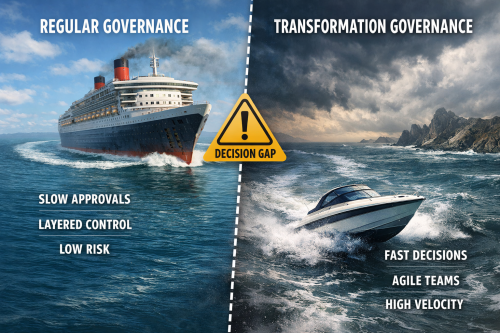
Regular business governance protects the company for good reasons. It reduces risk, protects margin, and keeps operations stable. But transformation decisions do not behave like …


Michel Paquin is a Senior Commerce Transformation Leader and Senior Lead Consultant in Commerce Strategy at Valtech, based in Montreal. He helps organizations improve transformation execution through clearer governance, operating models, decision frameworks, and measurable outcomes. He writes about decision velocity, commerce transformation, AI adoption, and the systems that make change stick.
All new articles directly in your inbox? Subscribe to my Entreprise Transformation Newsletter
* Please note that I am unable to accept mandates outside of my engagement with Valtech.