Tag: Transformation
-
The Unheld Ground
A retired Marine turned cybersecurity specialist told me something that has nothing to do with networks and everything to do with leadership: the job isn’t finished when the fix goes in — that’s when the real work starts. Most organizations plan for taking the hill. Almost none plan for holding it. The Unheld Ground is… Read More
Written by

-
The Visible Anchor
We were lost in Cádiz — or thought we were. The city’s old town curls and doubles back with no straight lines to follow, but our ship, 16 stories of white hull and the tallest thing in town, was visible from almost anywhere. We hadn’t been lost. We’d just forgotten to look up. That’s the… Read More
Written by

-
The Shared Circuit
Last year, we were leaving the main dining room on a Mediterranean cruise when the lights went out. Not just the lights — everything. Propulsion, water, even the toilets, which need electricity to run the pumps that drain the waste. For two hours, the ship drifted quietly somewhere south of Italy, dark from bow to… Read More
Written by

-
The Story Your Team Is Protecting
A man hesitating between a croissant and a muffin reminded me of something I see in boardrooms every week. Teams don’t stall because of data. They stall because they’re protecting a story. This article shows why identity beats logic, and how to move decisions forward without breaking what people value. Read More
Written by

-
Why Transformation Teams Need a Different Clock
In my kitchen, two clocks never agree. And that is exactly why they work. Companies try to run transformation on the same clock as operations. That is why decisions stall. Transformation needs a different clock. Not to move faster, but to stop reopening the same decision again and again. Read More
Written by

-
Decision Velocity Is the Missing Operating System
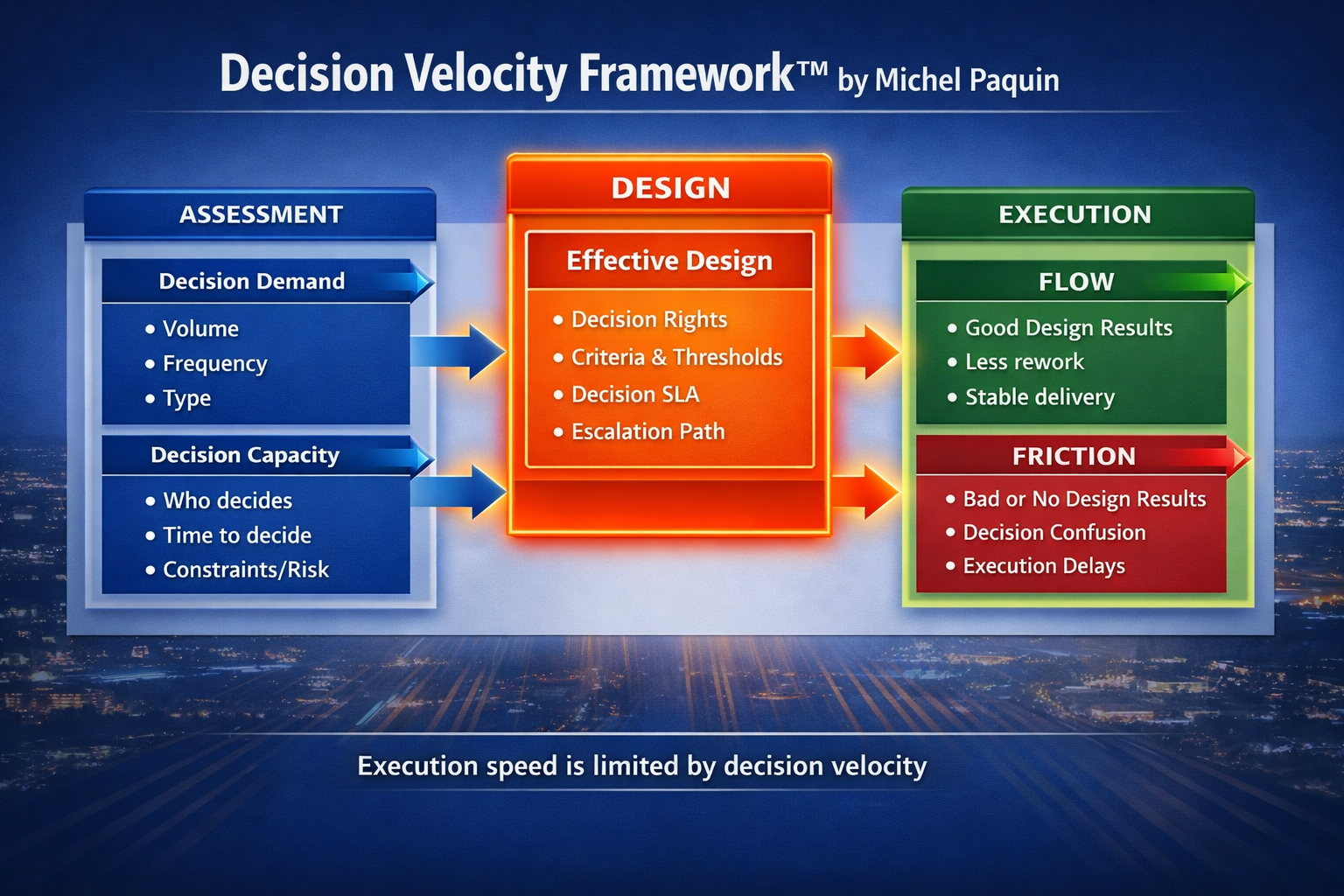
Execution speed is limited by decision velocity. In most transformations, agencies can execute faster than clients can decide. The result: delays, rework, and rising costs. The Decision Velocity Framework shows how to align decision demand, capacity, and design to restore flow and stabilize delivery. Read More
Written by