
Estimated reading time: 5 minutes
For leaders running transformations who want execution speed without losing control, this framework turns decisions into a scalable capability. Decisions needs to move as fast as delivery.
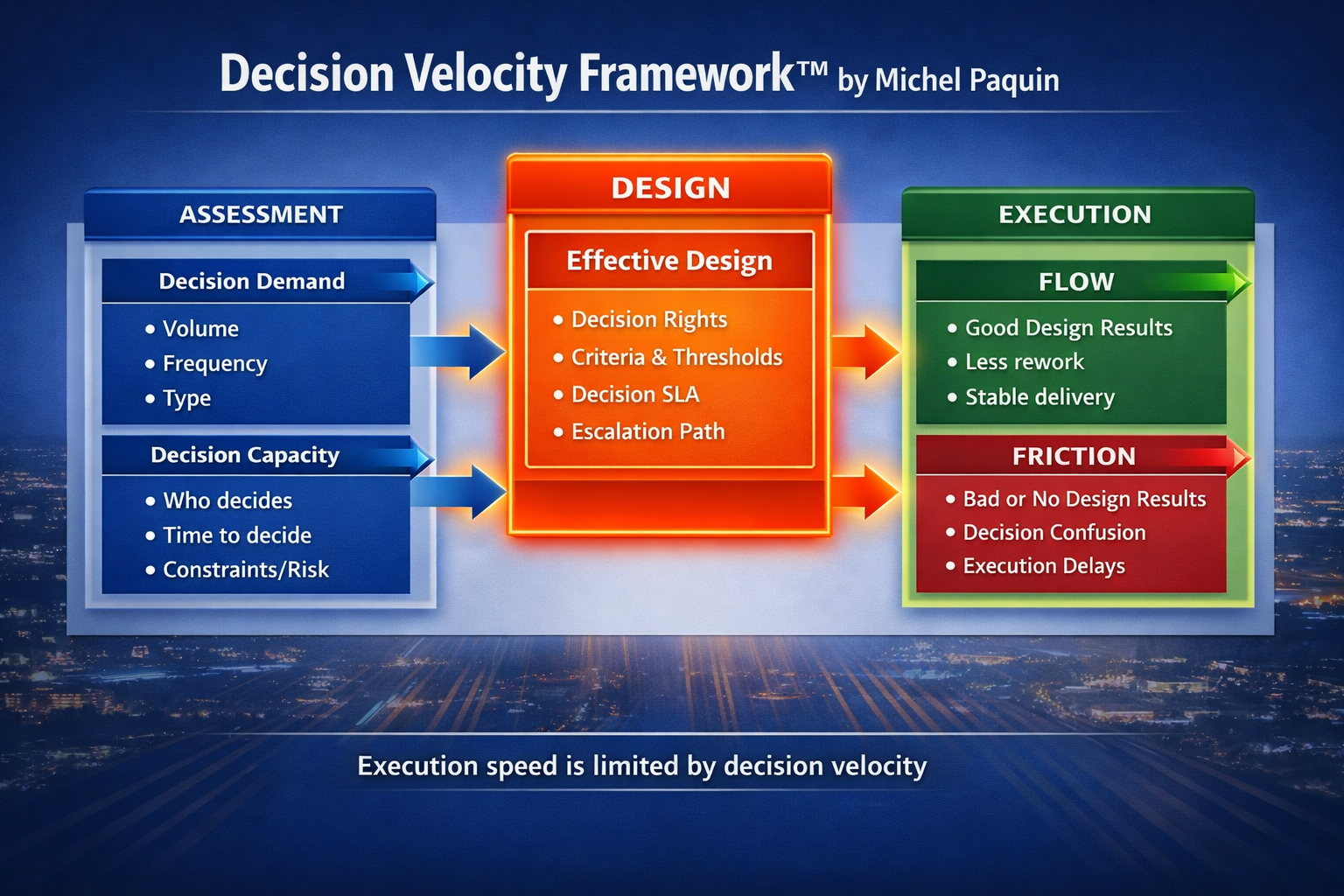
Most transformation delays are not caused by delivery teams or technology. They are caused by a mismatch between decision demand and decision capacity, combined with poorly designed decision mechanisms. Organizations underestimate how many decisions are required and overestimate their ability to make them quickly. When decision rights, criteria, SLAs, and escalation paths are unclear, decisions stall, rework increases, and execution slows down. Decision Velocity Framework solves this by structuring decision-making as a system: assessing demand versus capacity, designing decisions to be executable, and enabling flow in execution. When decisions are well designed, teams move faster with less friction. When they are not, confusion and delays compound. Execution speed is not a delivery problem. It is a decision system problem.
Agency execution speed is limited by the Client decision velocity.
Michel Paquin
Table of contents
- This framework comes from experiences
- The moment everything slows down
- The real problem: a broken decision system
- 1. Assessment: Decision Demand vs Decision Capacity
- 2. Design: The missing layer
- 3. Execution: Flow vs Friction
- When this does NOT appl y
- What to do this week
- Facts that matter
- FAQ
- Glossary
- Executive Takeaways
This framework comes from experiences
Most of my work starts the same way.
A Discovery mandate.
Four to six weeks to define:
- The MVP
- The backlog
- The business requirements
- The scope
We align teams.
We clarify priorities.
We build momentum.
At the end, everything is ready.
Then implementation starts.
And that’s when reality shows up.
The moment everything slows down
The agency is ready to execute. Designs are validated. Dependencies are mapped.
Questions are clear.
But the answers don’t come.
Not because people don’t know.
Because decisions don’t move
- “We need to validate this internally”
- “Let’s bring one more stakeholder”
- “We should not rush this”
Meanwhile, delivery is waiting.
And slowly:
- Timelines stretch
- Costs increase
- Frustration builds
Everyone tries to fix delivery.
But the problem is somewhere else.
The real problem: a broken decision system
What I consistently observe is this:
The agency can execute faster than the client can decide.
And this creates a structural gap.
Not a capability gap.
A system gap.
This is exactly what the framework captures.
The Decision Velocity Framework
The model is simple, but most organizations never design it explicitly.
It has three parts:
- Assessment
- Design
- Execution
And one core idea:
Decisions are a system, a flow system.
1. Assessment: Decision Demand vs Decision Capacity
This is where the problem starts.
Decision Demand
Every transformation generates decisions.
Not a few. Hundreds. Sometimes thousands.
Defined by:
- Volume: how many decisions
- Frequency: how often
- Type: strategic, operational, exceptions
Most organizations underestimate this.
Decision Capacity
Now compare that with the ability to decide:
- Who decides
- How long it takes
- Constraints and risk tolerance
This is where things break.
Because most organizations are designed to:
- Reduce risk
- Increase validation
- Avoid mistakes
Not to decide fast.
Mismatch creates risk
When demand exceeds capacity:
- Decisions queue
- Teams wait
- Work stalls
And no one sees it clearly.
Because we don’t measure decision systems.
We measure delivery.
2. Design: The missing layer
This is the core of the framework.
And the part that is almost always missing.
Most organizations believe governance is:
- Meeting cadence
- Steering committees
- Status reporting
That’s not decision design.
That’s coordination.
What “effective decision design” actually means
A decision is executable only if four things are explicit:
1. Decision Rights
- One accountable owner.
- Not consensus.
- Not shared ownership.
2. Criteria & Thresholds
What defines a valid decision?
Not opinions. Not preferences.
Clear rules.
3. Decision SLA
How fast the decision must be made.
Without time boundaries, decisions expand.
4. Escalation Path
What happens when a decision cannot be made.
Without this, everything escalates informally.
Without design → friction
When these elements are missing:
- Decision confusion
- Endless validation loops
- Reopened topics
- Execution delays
With design → flow
When these elements are clear:
- Decisions close
- Teams move
- Work stabilizes
Good design creates flow.
3. Execution: Flow vs Friction
Execution is not where problems start.
It’s where they show up.
Flow (green zone)
When decision design is strong:
- Good design results
- Less rework
- Stable delivery
Teams don’t stop.
They move.
Friction (red zone)
When decision design is weak:
- Decision confusion
- Rework
- Delays
And this is exactly what most transformations experience.
Why this happens (and no one says it clearly)
Clients are not slow because they are incapable.
They are slow because the system pushes them to be.
They are optimizing for:
- Risk avoidance
- Budget control
- Reversibility
And in Time & Material environments:
Every decision feels like a potential trap.
So people hesitate.
They validate.
They escalate.
They delay.
The invisible loop
This is the pattern I see repeatedly:
- Decision is unclear
- More people get involved
- Time increases
- Cost increases
- Pressure increases
- Fear increases
- Decision slows even more
And now you have:
Friction everywhere.
Not because of people.
Because of design.
A simple way to see it
Look at your program and ask:
- Are teams waiting for decisions?
- Are decisions being revisited?
- Are escalations frequent but unclear?
If yes:
You don’t have an execution problem. You have a decision velocity problem.
When this does NOT apply
This framework will not solve everything.
It does not apply when:
- Strategy is unstable
- Leadership avoids accountability
- Risk tolerance is undefined
- The organization requires consensus for every decision
In those cases, the issue is structural leadership alignment.
What to do this week
You don’t need to redesign everything.
Start small.
- Identify 3 decisions currently blocking delivery
- For each, define:
- One owner
- Clear criteria
- A decision SLA (48–72h)
- An escalation path
- Make it visible
- Enforce it
That’s enough to change the dynamic.
Facts that matter
- McKinsey & Company shows that slow decision-making is a major driver of execution inefficiency.
Source: https://www.mckinsey.com/business-functions/organization/our-insights/the-case-for-decision-intelligence (2019) - Bain & Company highlights that effective decision processes strongly correlate with performance and speed.
Source: https://www.bain.com/insights/decisions-drive-performance/ (2013) - Harvard Business Review emphasizes that unclear decision rights create delays and confusion.Source: https://hbr.org/2017/01/the-power-of-clear-decision-rights (2017)
FAQ
Why do decisions slow down during transformation?
Because the perceived risk of being wrong increases, while decision frameworks remain unclear.
Is governance the problem?
Not governance itself. Poorly designed governance is.
Can this work in large enterprises?
Yes. The larger the organization, the more critical decision design becomes.
What is the fastest lever to improve execution?
Clarify decision ownership, criteria, and timing for recurring decisions.
Glossary
- Decision Velocity: Speed and clarity at which decisions move
- Decision Demand: Volume and frequency of decisions required
- Decision Capacity: Ability of the organization to decide
- Decision Friction: Delays and confusion in decision-making
- Decision Flow: Smooth progression of decisions enabling execution
Executive Takeaways
- Execution speed is limited by decision velocity
- Most delays come from decision system mismatch
- Governance without decision design creates friction
- Agencies often move faster than clients can decide
- Flow is the result of well-designed decisions
-
In my kitchen, two clocks never agree. And that is exactly why they work. Companies try to run transformation on the same clock as operations. …
-
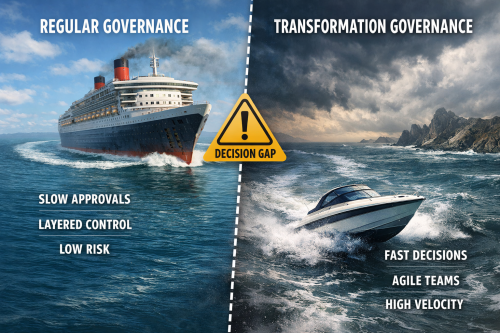
Regular business governance protects the company for good reasons. It reduces risk, protects margin, and keeps operations stable. But transformation decisions do not behave like …


Michel Paquin is a Senior Commerce Transformation Leader and Senior Lead Consultant in Commerce Strategy at Valtech, based in Montreal. He helps organizations improve transformation execution through clearer governance, operating models, decision frameworks, and measurable outcomes. He writes about decision velocity, commerce transformation, AI adoption, and the systems that make change stick.
All new articles directly in your inbox? Subscribe to my Entreprise Transformation Newsletter
* Please note that I am unable to accept mandates outside of my engagement with Valtech.