

Estimated reading time: 8 minutes
Why “being careful” can quietly stall meaningful progress
Prudence is useful. Every serious business needs it. But in transformation, “being careful” is often not a risk discipline. It is a social cover for hesitation. That hesitation usually comes from somewhere real: fear of being blamed, unclear decision rights, lack of trust, weak escalation paths, or a governance model built for steady-state operations instead of change. The problem is that it sounds respectable. Nobody wants to argue against caution. So delay slips into the room dressed like maturity. The test is simple. Real prudence reduces a specific risk and makes a decision stronger within a defined time. Fear disguised as prudence just asks for more time, more people, and more comfort, without changing the quality of the call. That is not a people problem. It is a system design problem.
Table of contents
“Fear rarely enters the room as fear.
Michel Paquin
It arrives dressed as prudence.”
The merge that looked safe
The other day, I was behind a car trying to merge into traffic.
There was room.
Not a huge opening. But enough. The kind of opening you take every day if you trust your judgment and keep moving.
The driver hesitated.
Then hesitated again.
By that point, the opening was gone. The car behind them hit the brakes. The flow got awkward. Now three or four drivers had to adjust because one person waited just a little too long.
What struck me was this: from inside that car, the hesitation probably felt responsible.
Careful. Measured. Sensible.
But from the outside, it created more friction than the original move ever would have.
Every time I see that, I think about transformation.
Because that is exactly how many organizations make important decisions.
The respectable language of delay
In business, fear rarely announces itself as fear.
It comes dressed better than that.
It says:
“Let’s make sure we’ve pressure-tested this.”
“We should be careful.”
“I just want a bit more confidence before we move.”
“This needs more alignment.”
Sometimes that is wisdom.
Sometimes it is simply fear with better branding.
The hard part is that the words sound responsible. They sound mature. They sound like leadership.
And in stable operations, they often are.
If you are changing a credit policy, touching margin logic, or exposing the company to regulatory risk, caution belongs in the room.
But transformation is different.
Transformation decisions are often made with partial information, moving dependencies, and time-sensitive windows. If you wait for the kind of certainty that business-as-usual governance expects, the moment passes. Teams stall. Work gets reopened. Energy drops. The backlog fills with half-decided items. Nothing looks dramatic on paper, but progress thins out week after week.
That is the hidden cost.
What is really happening underneath
When a team keeps saying “let’s be careful,” I do not immediately assume the people are weak or resistant.
I usually assume the system is teaching them that delay is safer than decision.
That can happen for a few reasons.
First, the cost of action is visible, but the cost of delay is not.
If we move and something goes wrong, there is a name, a meeting, and a trail. If we wait, the damage spreads quietly. A milestone slips. A dependency gets blocked. A workaround gets normalized. Adoption loses momentum. But because it happens in small pieces, nobody owns it cleanly.
Second, decision rights are unclear.
When nobody knows who can truly close the call, people keep adding voices. More review looks like diligence, but often it is just uncertainty about authority. Bain has long argued that strong decision effectiveness depends not only on decision quality, but also on speed, yield, and effort. In other words, a good decision system is not one that merely avoids mistakes. It is one that produces good decisions at the right pace and gets them executed.
Third, the organization confuses prudence with certainty.
In real transformation, leaders often have to act with incomplete information. That is not poor discipline. That is the job. Recent leadership writing from IMD and McKinsey makes the same broader point from different angles: uncertainty is now a normal management condition, and adaptability in decision-making has become a core executive requirement.
Fourth, nobody has designed a transformation-specific flow.
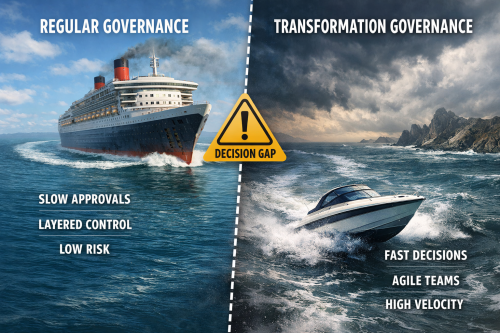
The regular operating model is built to protect the business. That is a good thing. It should not turn like a speedboat. It should turn like an ocean liner when the stakes require it.
But not every transformation decision belongs in that same lane.
If every product, process, customer, data, and operating-model decision has to move through the full weight of business-as-usual review, transformation becomes a hostage of the core machine it is trying to improve.
This is not caution.
It is governance mismatch.
A simple test for fake prudence
I like to use a simple filter when I hear careful language in a transformation setting.
I call it the Prudence Test.
1. What specific risk are we reducing?
Not general discomfort. Not vague exposure. Name the exact risk.
If the team cannot name it, the caution may be emotional, not operational.
2. What new information will change the decision?
This question matters a lot.
If two more weeks will produce a meaningful input, fine. Wait.
If two more weeks will only produce more conversation, you are not buying insight. You are renting comfort.
3. What is the cost of waiting?
Most teams are good at listing the downside of action.
Far fewer can state the downside of delay with the same discipline.
What slips? What reopens? What sits idle? What sequencing gets damaged? What confidence gets lost?
If you do not price delay, delay always looks cheap.
4. Who has the authority to close this?
If the answer is fuzzy, the issue is not prudence.
It is ownership.
5. What is the decision SLA?
Not every decision needs the same clock.
Some should close in 24 hours. Some in five days. Some need deeper review.
But if there is no explicit expectation for when a decision must be made, caution expands to fill the available space.
That is what systems do.
Where this idea can go wrong
This is not an argument for recklessness.
Some leaders hear critiques like this and overcorrect. They start celebrating speed for its own sake.
That is not the point.
Good transformation governance is not faster because it is careless. It is faster because it is clearer.
It defines who decides, what guardrails apply, when escalation is required, and how long a decision can stay open before it becomes drag.
Even Gartner’s guidance on urgent cost actions makes a version of this point: when speed matters, structure still matters too. Speed without structure creates a different kind of mess.
So no, the goal is not “just move.”
The goal is to remove fake prudence and replace it with explicit guardrails.
What to do this week
Pick one decision in your current transformation that has been “under review” for too long.
Then ask five questions:
- What exact risk is keeping this open?
- What evidence are we still waiting for?
- What is the cost of another two weeks?
- Who actually owns the call?
- What is the deadline to close it?
If the answers are vague, you have found a decision-friction point.
Do not blame the people.
Fix the design.
Because most stalled transformation work is not stuck on intelligence. It is stuck on permission.
And once you see that, a lot of polite language starts sounding different.
“Let’s be careful” may still be the right answer.
But it should no longer get a free pass.
Facts that matter
- Bain’s decision-effectiveness work argues that strong decision systems are not just about quality. They also depend on speed, yield, and effort, which supports the idea that “more careful” is not automatically “better.” Source: Bain & Company, Measuring decision effectiveness, published 2012.
- Bain also states that improving decision quality, speed, and implementation is directly correlated with stronger performance, and that improving them together has a multiplier effect. Source: Bain & Company, Score your organization to improve decision effectiveness, published 2012.
- Bain’s RAPID framework page makes the same core point in simpler language: effective decision making is closely linked to strong organizational performance, and successful companies make high-quality decisions at the right pace and execute them well. Source: Bain & Company, RAPID Decision-Making Framework, published 2023.
- IMD notes that leaders increasingly need comfort with ambiguity and uncertainty in decision-making, which supports the case that waiting for complete certainty is often unrealistic. Source: IMD, Why leaders don’t engage in strategic thinking, published January 9, 2025.
- IMD also argues that leaders in turbulent conditions need to make sound decisions without having all the information they would ideally want. Source: IMD, Surfing the tsunami: aligning leadership thinking in a turbulent business environment, published March 7, 2025.
- McKinsey’s work with senior leaders highlights the tension executives face when leading amid competing priorities and uncertainty, reinforcing that ambiguity is now a normal leadership condition rather than an exception. Source: McKinsey, The loneliest job? How top CEOs manage dilemmas and vulnerability, published August 7, 2024.
FAQ
How do I know whether my team is being prudent or just avoiding discomfort?
Look for specificity. Real prudence can name the exact risk, the missing information, the owner, and the time boundary. Avoidance usually stays vague and keeps expanding the review group without materially improving the decision.
Is faster decision-making always better?
No. Bad fast decisions can create expensive rework. The goal is not speed alone. The goal is decision clarity at the right speed, with clear guardrails, ownership, and escalation rules.
What usually causes fake prudence in transformation?
Usually not bad intent. More often it is fuzzy decision rights, invisible cost of delay, fear of blame, overloaded leaders, and business-as-usual governance being applied to transformation work that needs a different rhythm.
What is the easiest fix?
Start by putting a visible clock on key decisions. Once a decision has an owner, a due date, and a simple escalation path, vague caution has less room to hide.
When does this not apply?
It does not apply when the downside exposure is genuinely material and still undefined. If the team is dealing with major legal, regulatory, safety, or margin risk that is not yet understood, deeper caution is not drag. It is discipline.
Executive takeaways
- “Let’s be careful” is not automatically wisdom. Sometimes it is fear with better branding.
- If the cost of delay stays invisible, delay will keep winning.
- Transformation needs clear decision rights, guardrails, and decision SLAs, not just more meetings.
- The issue is often not courage. It is system design.
- Do not try to remove caution. Remove vague caution.
More Reading
-
In my kitchen, two clocks never agree. And that is exactly why they work. Companies try to run transformation on the same clock as operations. …
-
Regular business governance protects the company for good reasons. It reduces risk, protects margin, and keeps operations stable. But transformation decisions do not behave like …


Michel Paquin is a Senior Commerce Transformation Leader and Senior Lead Consultant in Commerce Strategy at Valtech, based in Montreal. He helps organizations improve transformation execution through clearer governance, operating models, decision frameworks, and measurable outcomes. He writes about decision velocity, commerce transformation, AI adoption, and the systems that make change stick.
All new articles directly in your inbox? Subscribe to my Entreprise Transformation Newsletter
* Please note that I am unable to accept mandates outside of my engagement with Valtech.