
Estimated reading time: 8 minutes
For CEOs, COOs, CIOs, and transformation leaders who need teams to keep moving when the data is incomplete but the business cannot wait.
Ambiguity tolerance is the leadership skill of making responsible decisions before certainty arrives. It does not mean guessing, improvising, or ignoring risk. It means knowing what must be true to move, what can be learned later, and what guardrails protect the business while the picture is still incomplete. Leaders who cannot act without full certainty create slow approvals, over-analysis, weak accountability, and teams that escalate everything upward. In practice, better decisions under uncertainty come from structure, not confidence: define the decision object, separate reversible from irreversible calls, set risk thresholds, name the owner, and agree on what evidence is sufficient. When leaders do this well, they increase decision velocity without turning governance into chaos. They turn uncertainty into managed movement.
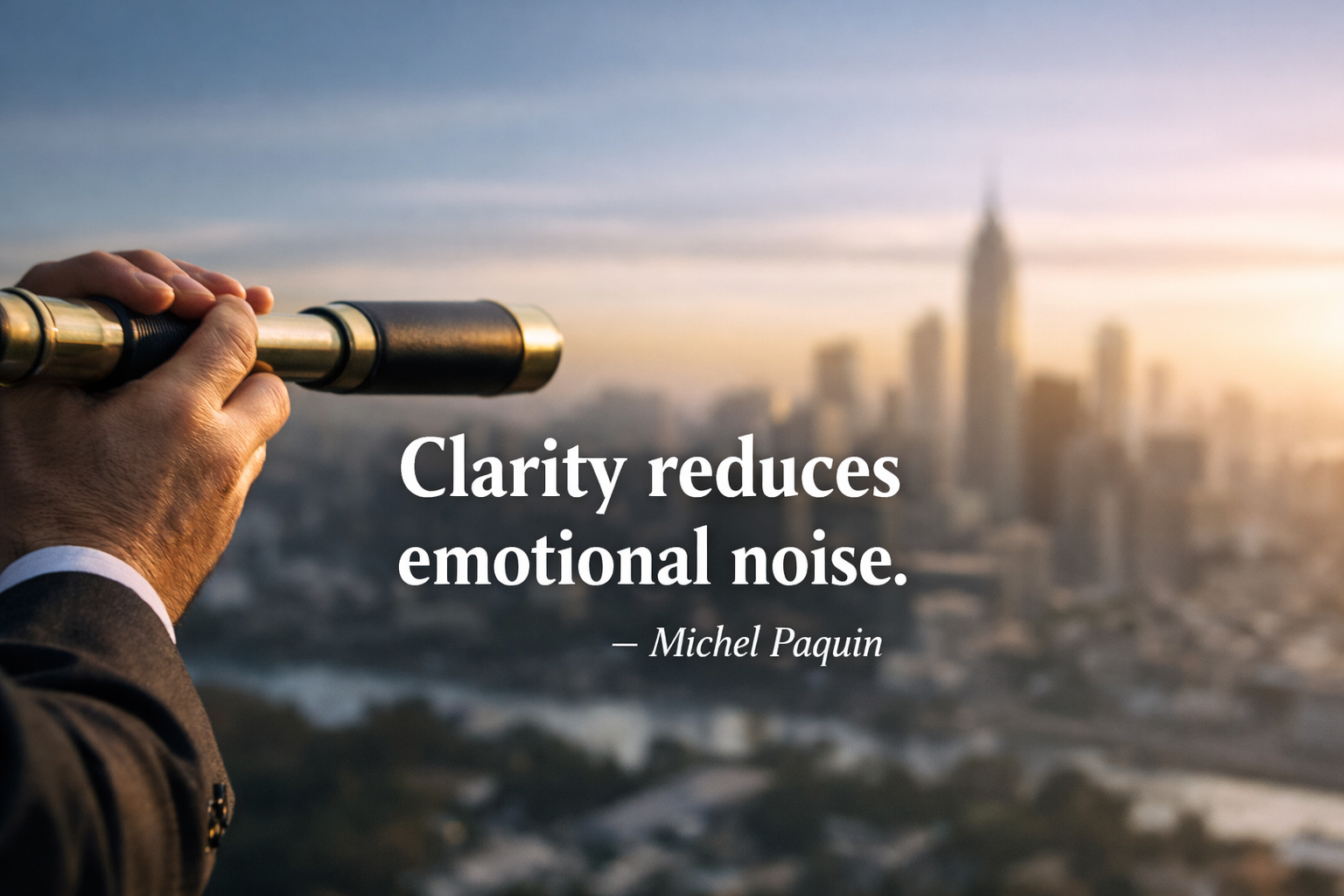
Clarity reduces emotional noise.
Michel Paquin
Table of contents
- I’m not comfortable deciding yet
- What ambiguity tolerance actually means
- Why some leaders freeze without certainty
- The hidden cost of certainty-seeking
- How to decide with incomplete information using guardrails
- When this advice does not apply
- What leaders should do this week
- Facts that matter
- FAQ
- Glossary
- Executive Takeaways
I’m not comfortable deciding yet
I have seen this moment more times than I can count.
An executive team is in a steering room. The slides are solid. The risks are known. The team has enough information to choose a direction. Not perfect information, but enough. Then the room tightens.
Someone asks for more analysis.
Someone else wants another validation step.
A third person says, “I’m not comfortable deciding yet.”
On the surface, it sounds disciplined. Responsible, even.
But often, that is not rigor. It is discomfort with ambiguity.
And that distinction matters.
Because in leadership, certainty is rarely available on schedule. Markets move before the forecast is complete. Customers react before the dashboard stabilizes. Teams need direction before every dependency is untangled. If a leader needs full clarity before making a call, the business does not become safer. It becomes slower, more political, and more dependent on escalation.
What ambiguity tolerance actually means
Ambiguity tolerance is the ability to make responsible progress when information is incomplete, unclear, or still evolving. Researchers describe tolerance for ambiguity as an individual difference that shapes how people respond to situations that are complex, novel, or insoluble.
This is not the same as recklessness.
A reckless leader ignores uncertainty.
A strong leader names uncertainty, bounds it, and decides anyway.
That is the skill.
Too many organizations treat uncertainty as a sign that the decision should stay open. In reality, uncertainty is a condition of modern leadership. The question is not whether ambiguity exists. The question is whether your leaders know how to act inside it.
The leaders who do this well are not calmer because they know more. They are calmer because they know what level of certainty is sufficient for this decision, at this moment, with this level of risk.
Why some leaders freeze without certainty
Some leaders freeze because they genuinely want to protect the business. Others freeze because the social cost of being wrong feels higher than the operational cost of being slow.
That fear is often invisible, but the pattern is easy to recognize:
The decision keeps reopening.
More people get invited.
The language becomes vague.
Nobody says no, but nobody closes.
This is where leadership psychology meets governance design.
If the environment punishes imperfect judgment, people wait. Amy Edmondson’s research defines psychological safety as a shared belief that the team is safe for interpersonal risk-taking. When that safety is low, people are less likely to speak up, test assumptions, or make calls that could later be challenged.
Now combine that with unclear decision rights.
If the owner is fuzzy, the threshold is fuzzy, and the escalation rule is fuzzy, then ambiguity feels dangerous. Leaders do not just lack certainty about the decision. They lack certainty about the consequences of deciding.
That is why some organizations confuse “more alignment” with better governance. In practice, it often means nobody feels protected enough to close the call.
The hidden cost of certainty-seeking
The cost of low ambiguity tolerance is rarely visible on a single slide.
It shows up as approval loops.
It shows up as late escalations.
It shows up as teams waiting for executive air cover on issues that should have been decided two levels lower.
This is not harmless delay. It is operational drag.
PMI reported that, on average, 11.4% of investment is wasted due to poor project performance. That number does not prove ambiguity is the only cause, but it does show how expensive weak decision systems become once delivery starts slipping.
Transformation evidence points in the same direction. McKinsey has reported that 70% of transformations fail, and that when line managers and frontline employees are not engaged, success rates collapse to 3%, versus 26% and 28% when those groups are engaged. That matters here because leaders who over-centralize uncertainty train the organization to wait rather than act.
This is the part many executives miss: the search for certainty does not remove risk. It often relocates risk to later in the timeline, where it becomes more expensive.
A decision delayed is not a decision avoided. It is usually a decision deferred into a worse context.
How to decide with incomplete information using guardrails
This is where governance becomes useful.
Not governance as ceremony. Governance as a system that makes uncertainty manageable.
Here is a practical model I use.
The Guardrails for Incomplete Decisions
1. Define the decision object clearly
A decision object is the exact thing being decided. If the object is vague, the debate will sprawl.
Bad: “Let’s discuss the platform.”
Better: “Decide whether we approve vendor X for B2B self-service quoting in Canada for phase one.”
Clarity reduces emotional noise.
2. Separate reversible from irreversible decisions
A reversible decision can be changed later at reasonable cost. An irreversible decision is hard, expensive, or risky to unwind.
Amazon popularized this logic as distinguishing lightweight, reversible decisions from one-way-door calls that should be handled more carefully. AWS uses the same principle in its operational guidance: centralize irreversible decisions and allow reversible ones to be made lower in the organization.
Most organizations treat too many decisions as irreversible. That is one reason they slow down.
3. Set risk thresholds before debate starts
A risk threshold is the level of downside the business is willing to accept without escalation.
Examples:
- spend under a defined amount
- no customer data exposure
- no regulatory exception
- reversible within one quarter
- limited brand impact
When thresholds are pre-agreed, leaders stop using fear as the decision method.
4. Name one decision owner
Not a committee. Not “the team.” One owner.
Advisers matter. Input matters. But accountability must land somewhere specific. Without a named owner, uncertainty expands and meetings become theaters of caution.
5. Define what evidence is sufficient
This is where many teams go wrong. They ask for complete evidence when they only need enough evidence.
Create a simple standard:
- what do we know?
- what do we assume?
- what would change the decision?
- what can we learn after launch?
That shifts the room from certainty-seeking to judgment.
6. Put an escalation SLA on the decision
A decision SLA is the expected time limit for a decision at each level.
This matters because teams tolerate ambiguity better when they know uncertainty will not sit open forever. Time boundaries create movement. They also force leaders to distinguish between true risk and simple discomfort.
7. Review the quality of reasoning, not just the outcome
A good decision can still lead to a bad result. A bad decision can occasionally get lucky.
If leaders only reward outcomes, people become conservative and political. If leaders review the logic, assumptions, and guardrails used, teams learn how to decide better under uncertainty.
That is how ambiguity tolerance becomes an organizational capability, not just a personality trait.
When this advice does not apply
There are moments when slowing down is correct.
Do not force speed when:
- the decision creates material legal, regulatory, or safety exposure
- the choice is genuinely irreversible and the downside is existential
- the decision object is still undefined
- the organization has not set basic guardrails, owners, or thresholds yet
Ambiguity tolerance is not an excuse to bypass discipline. It is what allows discipline to work when reality is still incomplete.
What leaders should do this week
Start small and make it operational.
- Pick one decision area where your team regularly asks for “more clarity.”
- Review the last three delayed decisions in that area.
- Ask what was actually missing: data, ownership, threshold, or courage.
- Classify the decisions as reversible or irreversible.
- Define a “good enough to decide” evidence standard.
- Install a decision SLA and one named owner.
That alone will show you something important.
Most stalled decisions are not waiting for truth. They are waiting for permission, protection, or structure.
And that is why ambiguity tolerance is not just a personality trait.
It is a leadership skill.
And in practice, it is also a governance design choice.
Facts that matter
- Tolerance for ambiguity is recognized in research as an individual difference that predicts how people react to complex, novel, or insoluble situations. Source: Frontiers in Psychology, “Ambiguity tolerance in organizations: definitional clarification and perspectives on future research,” 2015.
- Psychological safety was defined by Amy Edmondson as a shared belief that the team is safe for interpersonal risk-taking, a condition closely linked to learning behavior in teams. Source: Harvard DASH / Administrative Science Quarterly, 1999.
- AWS guidance recommends centralizing irreversible decisions and allowing reversible decisions to be made lower in the organization. Source: AWS Well-Architected Framework, Operational Excellence Pillar, 2022 edition surfaced in current AWS documentation.
- PMI reported that an average 11.4% of investment is wasted due to poor project performance. Source: PMI Pulse of the Profession, 2020.
- McKinsey has stated that 70% of transformations fail, and separately reported that when line managers and frontline employees are not engaged, only 3% of respondents report success, compared with 26% and 28% when those groups are engaged. Sources: McKinsey, 2022 and 2021/2022-published research pages and PDFs.
FAQ
Is ambiguity tolerance something people are born with?
Not entirely. Research treats it partly as an individual difference, but organizations clearly shape how much ambiguity people can handle in practice. When decision rights, risk thresholds, and escalation rules are explicit, more people can act confidently under uncertainty.
How is ambiguity tolerance different from confidence?
Confidence is a feeling. Ambiguity tolerance is a capability. A confident leader can still make reckless calls. A leader with ambiguity tolerance knows how to move with incomplete information while using boundaries, ownership, and review mechanisms to limit downside.
What is the simplest guardrail to install first?
Start with reversible versus irreversible decisions. This single distinction immediately changes how much evidence, seniority, and discussion a decision really needs. It is one of the fastest ways to stop over-governing low-risk choices.
Why do teams escalate decisions that should stay lower?
Usually because the consequences of being wrong feel unclear or unsafe. If the owner, threshold, or escalation path is fuzzy, people escalate for protection. That is not weakness. It is often a rational response to poor governance design.
Can more data solve this problem?
Sometimes, but not usually by itself. More data helps when a real information gap exists. It does not help much when the true issue is unclear ownership, political exposure, or the absence of a “good enough to decide” threshold.
Glossary
Ambiguity tolerance: The ability to make responsible progress when information is incomplete or unclear.
Decision object: The exact issue or choice being decided.
Risk threshold: The pre-agreed level of downside the business will accept without escalation.
Decision SLA: The expected time limit for making a decision at a given level.
Reversible decision: A decision that can be changed later at reasonable cost.
Executive Takeaways
- Leaders do not need full certainty to decide well. They need clear guardrails.
- Low ambiguity tolerance often hides behind language that sounds like rigor.
- Most stalled decisions are caused less by missing data than by missing structure.
- Reversible versus irreversible is one of the most useful distinctions in governance.
- Teams move faster when the business defines ownership, thresholds, and decision timing.
-
In my kitchen, two clocks never agree. And that is exactly why they work. Companies try to run transformation on the same clock as operations. …
-
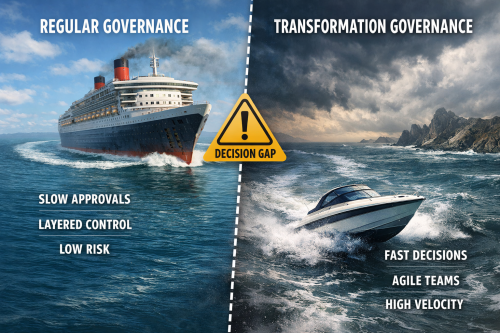
Regular business governance protects the company for good reasons. It reduces risk, protects margin, and keeps operations stable. But transformation decisions do not behave like …


Michel Paquin is a Senior Commerce Transformation Leader and Senior Lead Consultant in Commerce Strategy at Valtech, based in Montreal. He helps organizations improve transformation execution through clearer governance, operating models, decision frameworks, and measurable outcomes. He writes about decision velocity, commerce transformation, AI adoption, and the systems that make change stick.
All new articles directly in your inbox? Subscribe to my Entreprise Transformation Newsletter
* Please note that I am unable to accept mandates outside of my engagement with Valtech.