
Estimated reading time: 7 minutes
For CEOs and transformation leaders who wonder why clear data still leads to slow or contested decisions.
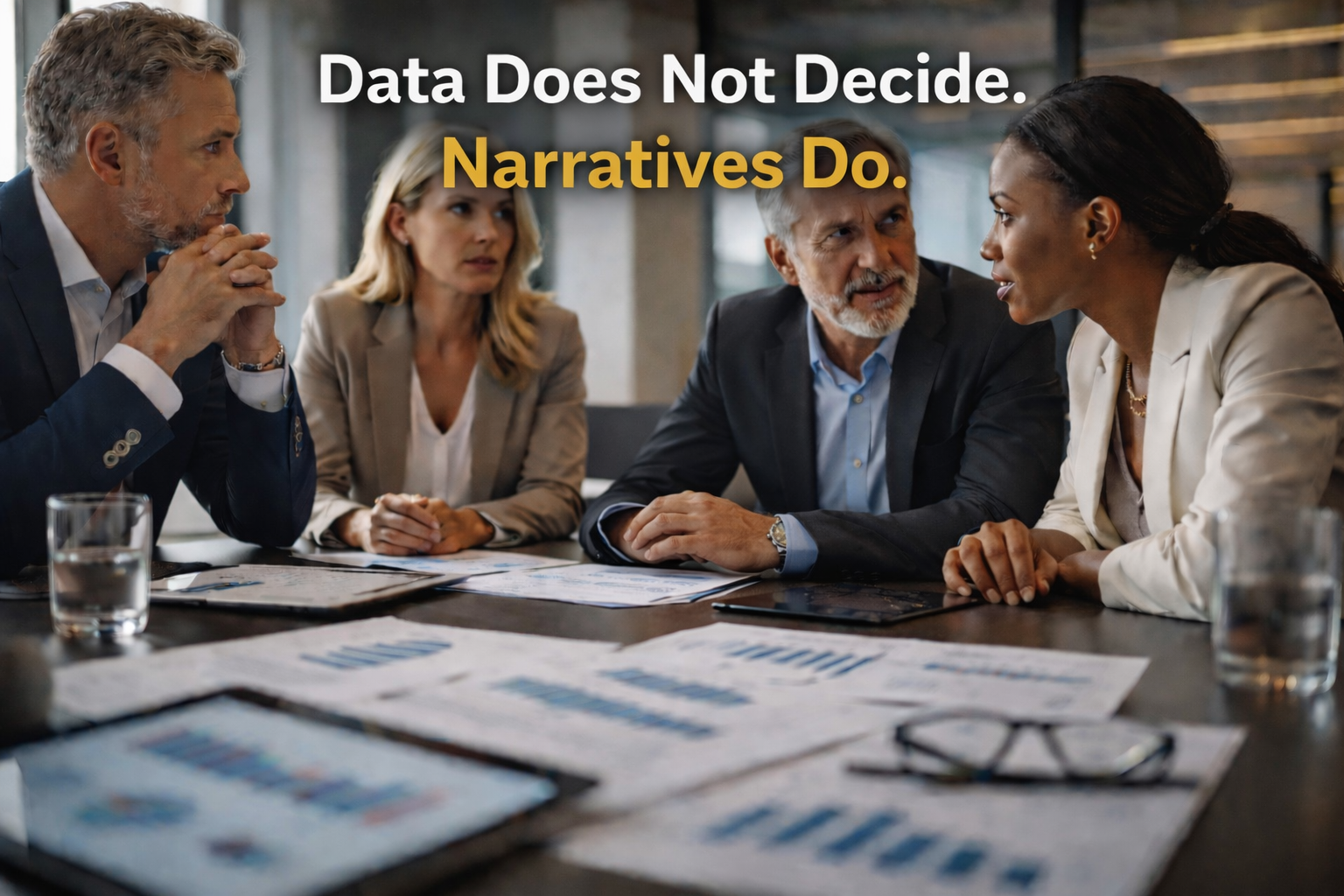
Teams rarely argue about data as much as they argue about what the decision means. A technology choice may signal that a previous investment failed. A governance change may signal that one team loses influence. A vendor decision may imply someone’s judgment was wrong. These interpretations form decision narratives: the stories people attach to a decision about identity, competence, and reputation. When these narratives are threatened, people defend them by reinterpreting data, asking for more analysis, or delaying escalation. The solution is not more information. It is making the narrative layer visible. Leaders who surface the story people are protecting can separate identity from evaluation, clarify the real decision object, and reduce the hidden friction that keeps organizations stuck even when the numbers are clear.
Data Does Not Decide. Narratives Do.
Michel Paquin
Table of contents
The Meeting Where the Data Was Clear but the Decision Was Not
A steering committee I was facilitating was reviewing a vendor selection.
The analysis had taken weeks.
Total cost, integration complexity, customer impact, implementation risk.
Everything was clear.
Vendor A scored higher on almost every dimension.
But the conversation kept drifting.
Someone asked if the integration team had reviewed the API documentation.
Another wondered if the financial model captured “long-term flexibility.”
A third suggested waiting one more month to gather more feedback.
The discussion sounded analytical.
But it wasn’t really about the analysis.
What was actually happening was something more human.
Vendor A would replace a platform that another executive had championed two years earlier.
The real tension was not about technology.
It was about what the decision would say about the past decision.
Every important decision in an organization contains this hidden layer.
I call it decision narrative.
What Is a Decision Narrative?
A decision narrative is the internal story people attach to a decision about identity, competence, reputation, or status.
It answers an unspoken question:
“What does this decision say about me, my team, or our past choices?”
Examples appear in almost every transformation program.
- “If we change platform, it means the original architecture was a mistake.”
- “If marketing owns this decision, IT loses authority.”
- “If we escalate this problem, it shows we failed to manage it.”
- “If we delay the launch, the program looks like it is off track.”
None of these statements are written in the business case.
But they are often more influential than the business case itself.
Because humans do not only optimize for outcomes.
They also protect identity.
Research in organizational behavior shows that identity threat strongly influences decision behavior, leading people to defend existing positions even when evidence suggests change.
Source: Harvard Business Review, “The Real Reason People Won’t Change,” Robert Kegan & Lisa Lahey, 2001
https://hbr.org/2001/11/the-real-reason-people-wont-change
Why Data Rarely Wins Against Narrative
Leaders often assume that better data will resolve disagreements.
In practice, narratives frequently override analysis.
Three mechanisms explain why.
1. Identity protection
A decision can implicitly judge a past choice.
If adopting a new platform suggests that the previous one failed, people instinctively defend the earlier narrative.
The debate becomes less about future performance and more about protecting professional identity.
2. Reputation risk
Decisions also signal competence.
People may fear that supporting a risky option could damage their reputation if the outcome is negative.
Behavioral economics research shows that people often avoid choices that could threaten status or credibility.
Source: Daniel Kahneman, Thinking, Fast and Slow, 2011.
3. Organizational memory
Past conflicts leave emotional traces.
If previous decisions created tension between teams, the narrative around new decisions often carries those memories forward.
This is part of what organizational theorist Karl Weick describes as sensemaking, the process through which people interpret events and construct shared meaning in organizations.
Source: Karl E. Weick, Sensemaking in Organizations, 1995.
The result is predictable.
Data becomes interpreted evidence, filtered through the story people want to protect.
The Narrative Collision Model
To understand these dynamics, it helps to visualize the forces in play.
I use a simple framework I wrote called the Narrative Collision Model.
Every significant decision contains three overlapping narratives.
1. Performance Narrative
This is the analytical layer.
It includes data, forecasts, risk assessments, and performance metrics.
It answers the question:
“What option performs best?”
Most governance frameworks focus almost entirely on this narrative.
2. Identity Narrative
This layer concerns professional identity.
It answers a different question:
“What does this decision say about the people involved?”
Examples:
- competence
- credibility
- ownership of past choices
- influence in the organization
When this narrative feels threatened, resistance appears.
3. Political Narrative
The third layer concerns influence and control.
It answers:
“What changes in terms of power or ownership if we choose this option?”
Decisions can shift authority between teams, platforms, or budgets.
When the identity or political narrative becomes stronger than the performance narrative, decision flow slows down.
More analysis appears.
Escalations multiply.
The decision loops back through the system.
Not because the data is unclear.
Because the story behind the decision is unresolved.
How Leaders Surface the Narrative Layer
The most effective leaders do not try to eliminate narratives.
They make them discussable.
Here are four practical techniques.
1. Name the narrative safely
A simple question can reveal the hidden tension:
“What story might people tell about themselves if we choose this option?”
This allows people to acknowledge identity concerns without assigning blame.
2. Separate evaluation from identity
Leaders can frame decisions as learning rather than verdicts.
Instead of:
“We are replacing the previous solution.”
Say:
“We are updating the architecture based on what we have learned.”
This subtle shift protects identity while allowing progress.
3. Clarify the decision object
Narratives often intensify when the decision itself is ambiguous.
Example:
Instead of asking:
“Should we change platform?”
Clarify the object:
“Are we deciding about the next three years of architecture, or about whether the previous program succeeded?”
Those are different decisions.
Mixing them creates narrative conflict.
4. Make reversibility explicit
People defend narratives more aggressively when decisions feel irreversible.
Amazon popularized the distinction between Type 1 and Type 2 decisions, where reversible decisions should be made quickly and experimentally.
Source: Jeff Bezos, Amazon Shareholder Letter, 2016
https://www.sec.gov/Archives/edgar/data/1018724/000119312517121297/d369498dex991.htm
When teams know a decision can be revisited, identity threat decreases.
When This Advice Does NOT Apply
There are situations where narrative dynamics are not the main problem.
For example:
- When the decision object is genuinely unclear
- When data quality is weak or incomplete
- When accountability for the decision owner is undefined
- When governance forums lack the authority to decide
In those cases, the issue is structural rather than narrative.
Fix the decision architecture first.
Facts That Matter
- Identity threat can cause individuals to resist information that challenges their self-concept or prior decisions.
Source: Harvard Business Review, Kegan & Lahey, 2001
https://hbr.org/2001/11/the-real-reason-people-wont-change - Psychological safety significantly improves team learning and performance by allowing people to take interpersonal risks.
Source: Amy Edmondson, Harvard Business School, 1999
https://journals.sagepub.com/doi/10.2307/2666999 - Sensemaking theory explains how people interpret events and construct meaning collectively in organizations.
Source: Karl E. Weick, Sensemaking in Organizations, 1995. - Amazon distinguishes between reversible and irreversible decisions to increase decision speed.
Source: Jeff Bezos, Amazon Shareholder Letter, 2016
https://www.sec.gov/Archives/edgar/data/1018724/000119312517121297/d369498dex991.htm
FAQ
Why do teams keep debating decisions even when the data is clear?
Because decisions carry meaning beyond performance. They signal competence, ownership, and influence. When a decision threatens identity or reputation, people instinctively reinterpret data or ask for more analysis. The debate is rarely about numbers alone. It is about what the outcome says about the people involved.
How can leaders reduce narrative conflict in decision meetings?
Leaders can surface the narrative layer by asking questions about identity and ownership. Clarifying the decision object and separating evaluation from personal judgment also helps. When people feel their professional credibility is protected, they become more open to the analytical discussion.
Are decision narratives always negative?
No. Narratives help people interpret complex situations and create shared meaning. Problems arise only when the narrative layer remains invisible. When leaders acknowledge it openly, narratives can support alignment rather than block progress.
Is this the same as office politics?
Not exactly. Politics often refers to intentional influence or power struggles. Decision narratives are broader. They include identity protection, reputation risk, and collective meaning-making. Even well-intentioned teams experience them.
Glossary
Decision Narrative
The story individuals attach to a decision about identity, competence, or reputation.
Narrative Collision Model
A framework describing the interaction between performance, identity, and political narratives in decision-making.
Identity Threat
A psychological reaction that occurs when information challenges someone’s self-concept or competence.
Sensemaking
The process through which people interpret events and create shared understanding in organizations.
Actions to Do This Week
If your organization has a decision that keeps looping, try this exercise.
Ask the group three questions:
- What does the data say about the best option?
- What story about ourselves might this decision challenge?
- What ownership or influence would change if we choose it?
Often the real obstacle becomes visible within minutes.
Once the narrative is explicit, the decision usually becomes much easier.
Executive Takeaways
- Teams do not only evaluate data. They also protect identity and reputation.
- Hidden narratives often explain why decisions stall despite strong analysis.
- The Narrative Collision Model shows the interaction between performance, identity, and political narratives.
- Leaders accelerate decisions by surfacing the story behind the debate.
- When identity is protected, organizations can focus on performance.
Explore more

A grocery line works beautifully when every item follows the usual flow. But add one exception, and the whole system slows down. Transformation has the …

Michel Paquin is a Senior Commerce Transformation Leader and Senior Lead Consultant in Commerce Strategy at Valtech, based in Montreal. He helps organizations improve transformation execution through clearer governance, operating models, decision frameworks, and measurable outcomes. He writes about decision velocity, commerce transformation, AI adoption, and the systems that make change stick.
All new articles directly in your inbox? Subscribe to my Entreprise Transformation Newsletter
* Please note that I am unable to accept mandates outside of my engagement with Valtech.