
Estimated reading time: 10 minutes
For CEOs, COOs, CIOs, and transformation leaders who want to use frustration, defensiveness, and avoidance to find the operating model failures hiding behind human reactions.
Emotions in transformation are often treated as distractions to manage, but repeated emotions are usually diagnostic clues. Frustration often points to blocked flow, rework, or impossible trade-offs. Defensiveness often points to unclear accountability, hidden veto power, or KPI collisions. Avoidance often points to unsafe escalation, role ambiguity, or decisions nobody feels protected to make. The mistake leaders make is coaching the behavior before they inspect the system producing it. A better approach is to treat emotion like smoke. Do not argue with it. Trace it back to the source. Ask where it appears, around which decision, under what constraints, and with what consequences. When the same emotion shows up in the same moment repeatedly, the problem is rarely personality. It is usually design.
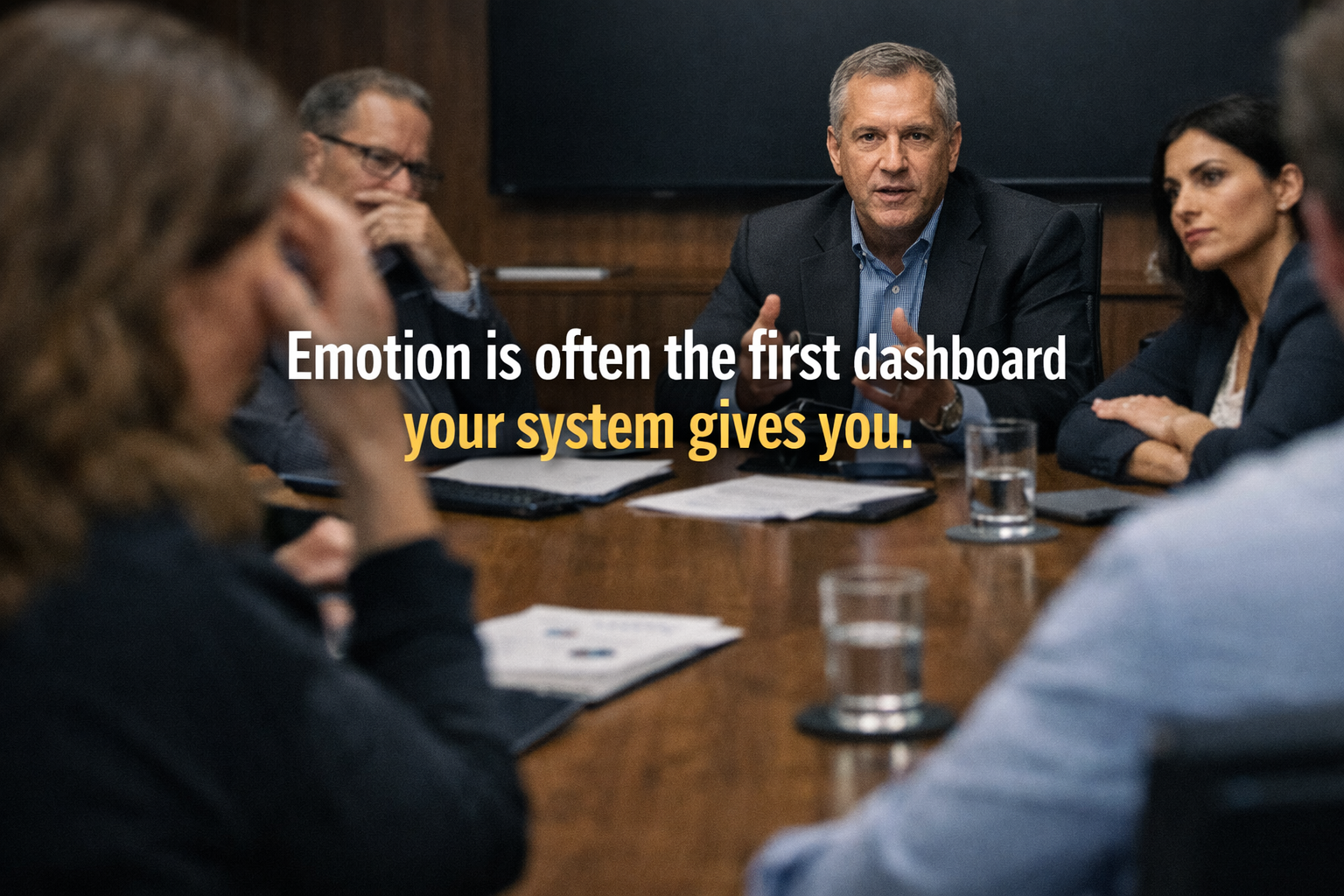
Emotion is often the first dashboard your system gives you.
Michel Paquin
Table of contents
- Emotion is not always the problem in the room
- Why leaders misread emotion
- A simple diagnostic model
- How to read the signal without over-psychologizing people
- A practical framework leaders can use this week
- When this advice does not apply
- Facts that matter
- FAQ
- Glossary
- When this matters most
- Actions to do this week
- Executive Takeaways
- Explore more
Emotion is not always the problem in the room
I have seen this scene more than once.
A steering committee is moving through the agenda. The slides are clean. The language is calm.
Then a simple question lands: who owns the decision, what changed since last week, or why the issue was not escalated earlier.
That is when the room changes.
One person gets visibly irritated. Another starts defending decisions nobody directly attacked. Someone else suddenly becomes vague, says “we need more alignment,” and proposes to come back next week.
Most leaders still read that moment as a people problem.
A personality issue. A confidence issue. Resistance. Politics. Lack of maturity.
Sometimes that is true. But not often enough to make it a useful default.
In transformation, repeated emotional patterns are usually diagnostics. They are signals that the operating model is forcing people into bad positions: unclear ownership, conflicting KPIs, unsafe escalation, weak decision rights, missing criteria, or handoffs that guarantee rework.
Emotion is not always the problem in the room.
Very often, emotion is the smoke from the problem in the system.
Why leaders misread emotion
Leaders are trained to separate “hard” operational issues from “soft” human issues. That split sounds neat, but it breaks down in real transformation work.
People do not experience governance as an org chart. They experience it as pressure.
They feel it when they cannot close a decision.
They feel it when they are accountable for an outcome they do not control.
They feel it when saying the truth too early is politically expensive.
They feel it when work comes back for the third time with different criteria.
That emotional reaction is not separate from the system. It is how the system is being lived by the people inside it.
This is also why psychological safety matters. Amy Edmondson’s research defined psychological safety as a shared belief that the team is safe for interpersonal risk taking, and linked it to learning behaviors such as asking for help, discussing errors, and seeking feedback. In other words, the willingness to speak up is not only a personality trait. It is shaped by the environment.
So when people do not raise issues, challenge assumptions, or escalate early, the answer is not automatically “they lack courage.”
Sometimes the system taught them silence.
A simple diagnostic model
Here is the model I use:
Emotion -> likely system failure -> what to inspect
This keeps the diagnosis practical. You are not trying to become a therapist in a steering committee. You are trying to identify where the operating model is creating predictable emotional friction.
1. Frustration usually points to blocked flow
Frustration often means the work cannot move cleanly.
Not because people are weak.
Because the path is broken.
Common structural causes:
- Rework loops caused by late criteria
- Handoffs without clear entry and exit conditions
- Approval layers that reopen already-made decisions
- Trade-offs that were never explicitly owned
- Dependencies that sit outside the team’s control
Frustration is often the emotional signature of wasted motion.
When the same team keeps saying “we already did this,” “this changed again,” or “we are waiting on three groups,” do not coach tone first. Inspect the workflow.
Ask:
- Where does work go backward?
- Which decision arrives too late to be useful?
- Which criteria were missing at the start?
- Who can block the work without owning the outcome?
2. Defensiveness usually points to exposed accountability
Defensiveness is rarely random.
It often appears when someone feels judged on outcomes without having the authority, criteria, or protection needed to make a good call. It can also appear when status is threatened, incentives conflict, or silent vetoes are operating in the background.
Chris Argyris’s work on defensive routines is useful here. He showed that smart, capable professionals often protect themselves from embarrassment or threat through patterns of bypass, self-censorship, and non-testable reasoning. Those patterns can become organizational, not just individual.
In plain language, defensiveness is often a clue that the system makes truth feel dangerous.
Common structural causes:
- Accountability without decision rights
- Metrics that punish local transparency
- Forum design that turns updates into public cross-examinations
- Hidden stakeholders with late-stage override power
- Escalation rules that are unclear or selectively applied
Ask:
- Is this person protecting ego, or protecting themselves from predictable exposure?
- What can they be blamed for that they cannot actually control?
- What decision right is missing?
- What veto power is informal rather than explicit?
3. Avoidance usually points to unsafe escalation or ambiguous ownership
Avoidance is one of the most expensive signals because it often looks harmless.
People defer.
They ask for more alignment.
They schedule another review.
They wait for more data.
They stay vague.
The surface looks polite. The cost is delay.
Avoidance usually appears when one of three things is true:
- No one knows who owns the call
- People know who owns it, but escalation feels unsafe
- Delay has lower social cost than decision
That third one matters.
In many organizations, being late is survivable. Being visibly wrong is not.
So people delay.
Research on role ambiguity consistently links unclear roles to stress, reduced engagement, and emotional exhaustion. The WHO also notes that workplace stress can be driven by poor work organization, poor work design, lack of control, and lack of support.
Avoidance is often what ambiguity looks like in motion.
Ask:
- Who is expected to decide this?
- By when?
- With what criteria?
- What happens if they escalate bad news early?
- What happens if they delay?
How to read the signal without over-psychologizing people
This is where leaders either become useful or unhelpful.
The wrong move is to label people too quickly.
Do not jump from one emotional moment to “this leader is fragile” or “that team is resistant.”
Use pattern logic instead.
Four diagnostic rules
Rule 1: Look for repetition
If the same emotion shows up across multiple people, it is probably not about personality.
Rule 2: Locate it in the workflow
If frustration always appears at the same handoff, or defensiveness always appears in the same forum, inspect the mechanism there.
Rule 3: Compare before and after clarity
If the emotion drops once ownership, criteria, or thresholds are made explicit, the system was the issue.
Rule 4: Separate intensity from usefulness
Not every emotional display is valid, but even exaggerated emotion can still point to a real structural fault.
This is the key definition I use with clients:
An emotional pattern becomes an operational signal when it is repeated, situational, and tied to a specific workflow moment.
Michel Paquin
That is when you stop asking, “Why are they reacting like this?”
And start asking, “What does the system keep making them run into?”
A practical framework leaders can use this week
Here is a simple model.
The Signal Read method
1. Name the emotion neutrally
Not “people are being difficult.”
Say: “I am noticing frustration around this dependency,” or “I am noticing avoidance when this decision comes up.”
2. Locate the moment
Where exactly does it appear?
- intake
- prioritization
- architecture review
- legal/compliance review
- budget approval
- launch readiness
- post-go-live issue handling
3. Identify the likely structural gap
Check these first:
- unclear decision owner
- unclear decision category
- missing criteria or thresholds
- no escalation SLA
- conflicting KPIs
- hidden veto
- handoff without acceptance rules
4. Fix the mechanism, not only the behavior
Examples:
- assign one accountable owner
- define thresholds for exceptions
- publish escalation timing
- redesign forum agendas around decisions, not updates
- document criteria before debate starts
- align KPI ownership to the actual decision right
5. Re-test in the next cadence
If the emotion reduces, you fixed a real cause.
If it does not, inspect incentives, capability, or interpersonal behavior next.
When this advice does not apply
This article is not saying every emotional reaction is wise, accurate, or useful.
There are cases where the root issue is not structural.
When to be careful
- The pattern is isolated to one individual across many contexts
- The person lacks the capability required for the role
- Incentives reward obstruction or territorial behavior
- There is a direct conduct issue that requires management, not redesign
The point is not to romanticize emotion.
The point is to stop dismissing it too early.
Facts that matter
- Amy Edmondson’s 1999 research defined psychological safety as a shared belief that the team is safe for interpersonal risk taking and linked it to team learning behaviors such as asking for help, discussing errors, and seeking feedback. Source: Harvard Business School / Administrative Science Quarterly (1999)
- Edmondson later argued that people make a tacit interpersonal risk calculation before speaking up, asking questions, or reporting mistakes. Source: Harvard Business School working paper, Managing the Risk of Learning (2002)
- Chris Argyris described organizational defensive routines as self-reinforcing patterns that protect people from embarrassment or threat while blocking learning and truth-telling. Source: Teaching Smart People How to Learn, Harvard Business Review (1991), and related work on defensive routines
- Research on role ambiguity has linked unclear roles with lower engagement and negative employee outcomes, while WHO guidance on workplace stress points to poor work organization, lack of control, and lack of support as important causes of stress. Sources: PMC study on role ambiguity climate (2018) and WHO definition quoted in workplace stress review (2017)
FAQ
Are emotions in meetings a sign of poor leadership?
Not necessarily. Emotions are often a sign that people are carrying real pressure from the system. Poor leadership starts when those signals are dismissed, personalized too quickly, or used only to judge behavior instead of diagnosing the mechanism underneath.
How do I know whether frustration is a people issue or a process issue?
Look for repetition and location. If frustration appears across multiple people or always at the same point in the workflow, it is probably structural. If it follows one person everywhere regardless of context, then capability or behavior may be the better starting point.
What is the difference between avoidance and healthy caution?
Healthy caution still moves the work. It asks for the missing input, clarifies the trade-off, and commits to a decision path. Avoidance hides in vagueness, repeated delays, and endless alignment language that reduces exposure but does not reduce uncertainty.
Can defensiveness ever be useful as a signal?
Yes. Defensiveness often tells you where accountability is exposed without enough authority, clarity, or protection. It may not be comfortable, but it can reveal missing decision rights, hidden vetoes, or forum designs that punish transparency.
What should leaders do first when emotion rises in a meeting?
Do not rush to calm it down or correct the person. First ask what changed in the workflow, decision path, or accountability design to trigger that reaction. The goal is to convert emotion into diagnosis before turning it into judgment.
Glossary
Psychological safety
A shared belief that it is safe to take interpersonal risks such as asking questions, admitting mistakes, or speaking up.
Role ambiguity
A condition where responsibilities, expectations, or authority are unclear enough to create confusion and stress.
Defensive routine
A repeated pattern of self-protection that avoids embarrassment or threat but also blocks honest learning.
Decision right
The formally assigned authority to make a specific category of decision.
Escalation SLA
A defined time expectation for when an escalated issue must receive a response or decision.
When this matters most
This advice matters most in transformations where work crosses functions, systems, and approval layers.
Commerce, ERP, CRM, OMS, data, AI, and operating model work all create the same pattern: technical complexity on the surface, emotional friction underneath, structural ambiguity in the middle.
That is why leaders should stop asking teams to be calmer before they ask the system to be clearer.
Actions to do this week
- Watch one recurring meeting and note where frustration, defensiveness, or avoidance appears.
- Tie each emotional pattern to a specific workflow moment.
- Ask which mechanism is missing: owner, criteria, threshold, forum, escalation rule, or KPI alignment.
- Fix one structural issue before giving another speech about collaboration.
- Review whether the emotional pattern reduces in the next operating cadence.
Executive Takeaways
- Repeated emotions in transformation are often operational signals, not interpersonal noise.
- Frustration usually points to blocked flow, rework, or missing trade-off ownership.
- Defensiveness often reveals exposed accountability, hidden vetoes, or unsafe truth-telling.
- Avoidance usually signals ambiguous ownership or an escalation path people do not trust.
- The leadership move is to fix the mechanism before judging the person.
Explore more

A grocery line works beautifully when every item follows the usual flow. But add one exception, and the whole system slows down. Transformation has the …

Michel Paquin is a Senior Commerce Transformation Leader and Senior Lead Consultant in Commerce Strategy at Valtech, based in Montreal. He helps organizations improve transformation execution through clearer governance, operating models, decision frameworks, and measurable outcomes. He writes about decision velocity, commerce transformation, AI adoption, and the systems that make change stick.
All new articles directly in your inbox? Subscribe to my Entreprise Transformation Newsletter
* Please note that I am unable to accept mandates outside of my engagement with Valtech.