
Category: Governance
Governance isn’t bureaucracy. It’s the operating system that turns strategy into consistent execution. Here you’ll find practical frameworks to speed up decision-making, clarify decision rights, and install operating rhythms that reduce alignment overhead. The goal is simple: fewer bottlenecks, cleaner accountability, controlled risk, and measurable outcomes teams can deliver against.
-
The Perimeter Tour
In Cádiz, the hop-on-hop-off bus never actually enters the old town — the streets are too narrow, built for feet, not vehicles. So the bus circles the perimeter while everything worth seeing sits untouched in the middle. It’s a full afternoon, a full loop, and a total miss. Organizations run the same tour: the dashboard,… Read More
Written by

-
The Shared Circuit
Last year, we were leaving the main dining room on a Mediterranean cruise when the lights went out. Not just the lights — everything. Propulsion, water, even the toilets, which need electricity to run the pumps that drain the waste. For two hours, the ship drifted quietly somewhere south of Italy, dark from bow to… Read More
Written by

-
The Transformation Tax Nobody Named
I was helping a friend pack up her mother’s house last month. Most boxes went fast — books, dishes, old furniture, labeled and taped in minutes. Then we got to a small box of kitchen utensils. Nothing valuable. Her mother picked up one spoon, turned it over, and didn’t put it in the box. “This… Read More
Written by

-
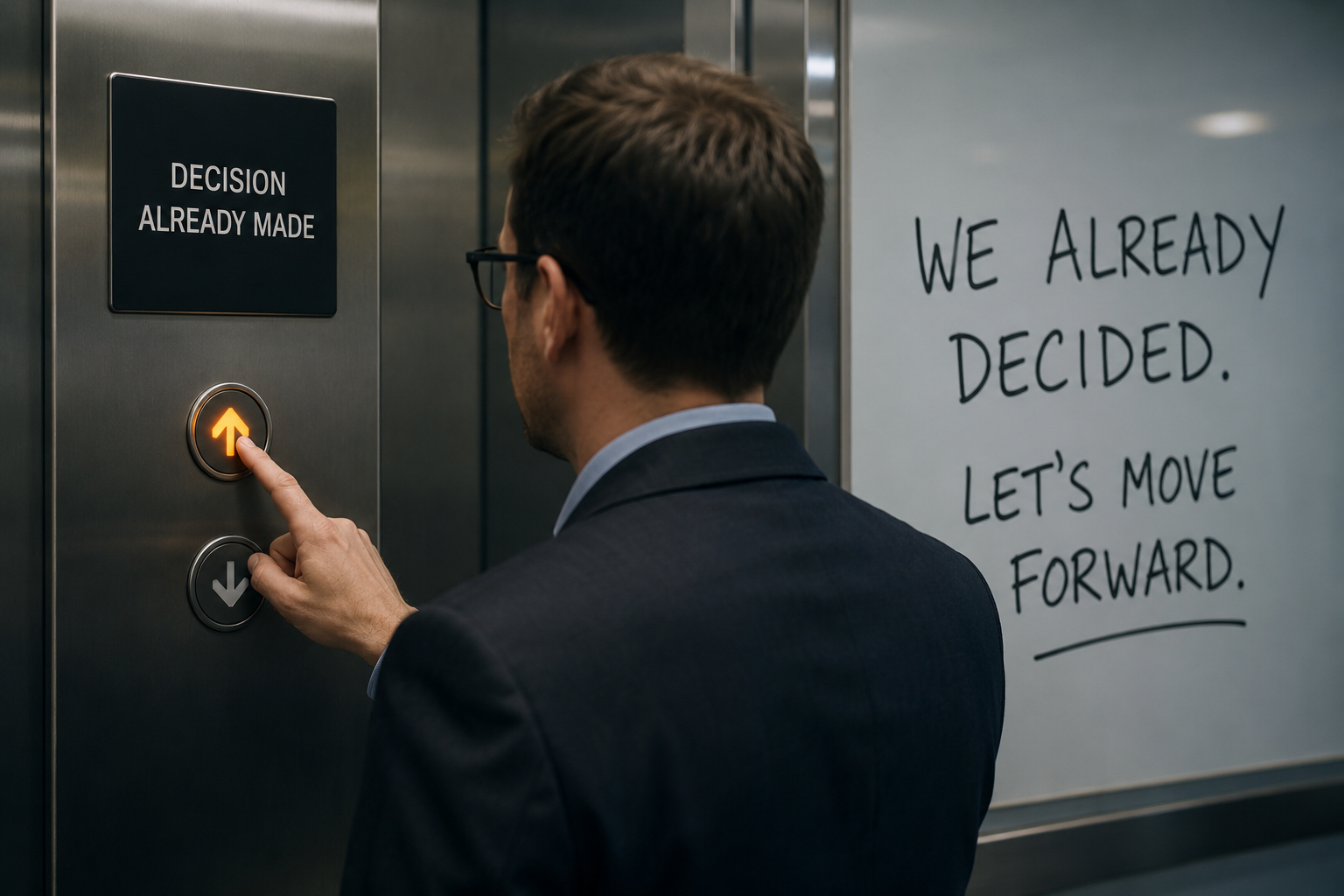
Again the Same Decision – The Elevator Button Problem
Someone presses the elevator button even though it is already lit. Then someone else does the same. Transformation teams do this too. They reopen decisions because the system never made the decision feel final. The problem is not impatience. It is missing closure. Read More
Written by
-
Different Work Needs a Different Transformation Decision Lane
A grocery line works beautifully when every item follows the usual flow. But add one exception, and the whole system slows down. Transformation has the same problem: good management flow can become the wrong lane when the work is full of exceptions, dependencies, and decisions that need a different rhythm. Read More
Written by

-
Fear Disguised as Prudence
A driver hesitates too long merging into traffic and suddenly creates more friction, not less. Organizations do the same thing in transformation. What sounds like prudence is often fear, weak decision rights, and an invisible cost of delay wearing a respectable suit. Read More
Written by