
Estimated reading time: 7 minutes
For CEO and COO steering committees who want a timeline they can trust, this gives a simple accompaniment framework, meeting agenda, and evidence checkpoints that prevent “surprise slippage.”
A transformation timeline is not a plan. It is a risk register with dates. In commerce programs, the schedule does not break because teams forgot tasks. It breaks because assumptions fail, dependencies drift, readiness lags, and evidence arrives late. The fix is not “more detail” in the Gantt. The fix is accompaniment: a steering cadence that manages timeline risk explicitly. Run every milestone like a claim that must earn proof. Track five registers next to the timeline: assumptions, constraints, dependencies, readiness, and evidence. Use a tight steering committee agenda that surfaces trending risks early and assigns executive actions to remove blockers. Your timeline becomes credible when it is governed as uncertainty, not promoted as certainty.
Table of contents
- The Steering Committee Comfort Trap
- A timeline is a promise. A plan is an operating system.
- The core idea: treat every milestone like a claim that must earn evidence
- The Timeline Risk Register framework (simple, executive-friendly)
- The CEO/COO steering committee agenda that prevents timeline surprises
- How to build a credible commerce transformation timeline (without false precision)
- Step 1: Start from milestones and constraints, not tasks
- Step 2: Convert major milestones into entry and exit criteria
- Step 3: Model capacity like a CFO, not like a PMO
- Step 4: Put adoption runway on the critical path
- Step 5: Use confidence ranges, not single-date theater
- Step 6: Use “proof checkpoints” every 2 to 3 weeks (each sprint)
- What this looks like in practice: a one-page steering committee pack
- When this advice does NOT apply
- Facts that matter
- FAQ
- Glossary
- Suggested internal links
- Executive Takeaways
The Steering Committee Comfort Trap
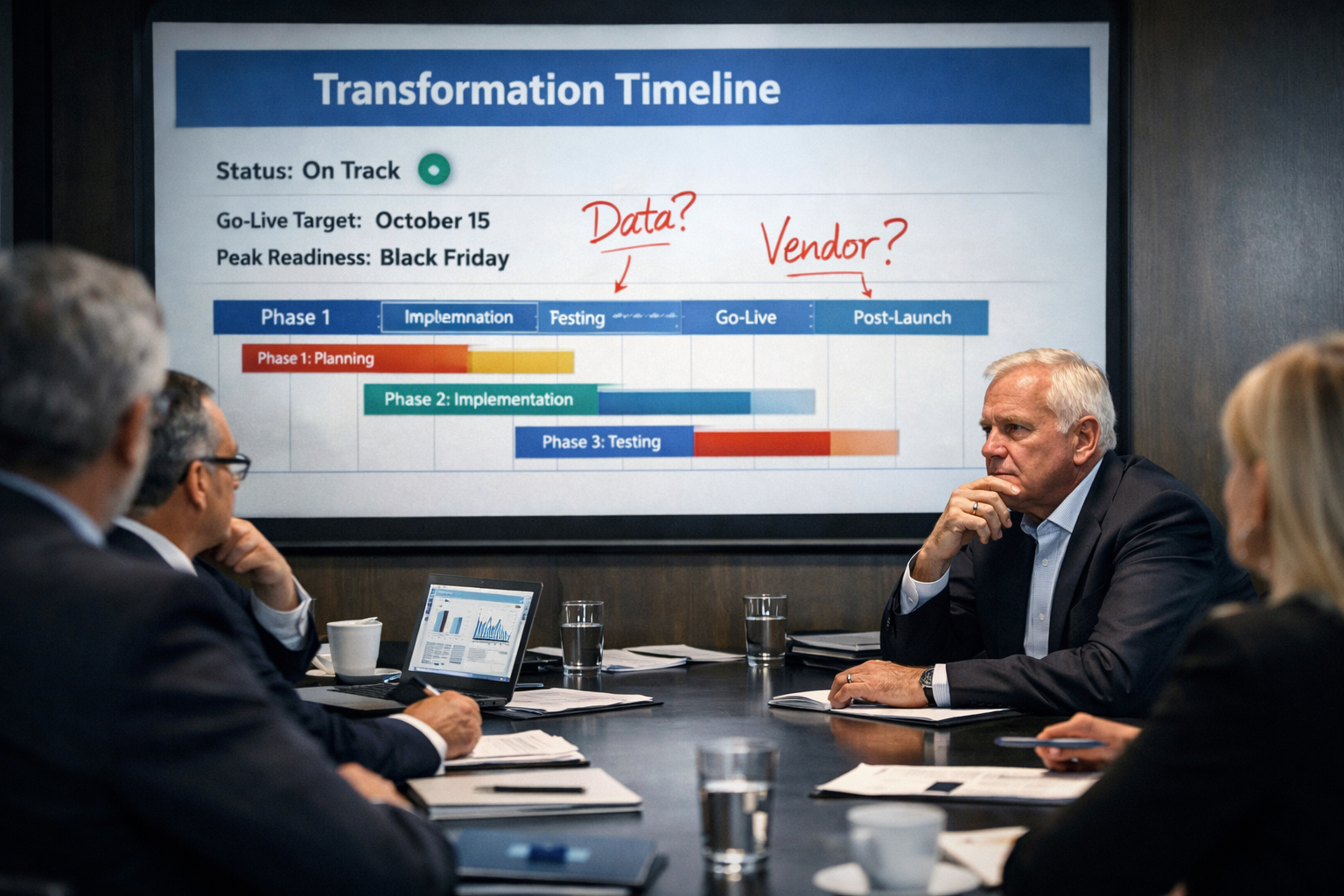
Month two of the program. Steering committee call.
The deck is clean. Status is green. The timeline slide looks confident.
Then the questions start: “Are we still on for peak?” “When do we start UAT?”
Silence, then qualifiers: “If the vendor delivers,” “If data is ready,” “If the business can spare SMEs.”
Nobody wants to be the one to say the date is shaky.
So the room agrees to “stay on course,” and the next meeting becomes the one where everyone is suddenly surprised.
A timeline is a promise. A plan is an operating system.
A timeline is a narrative of dates and sequencing. It helps leaders align and communicate intent.
A plan is the operating system that makes delivery predictable: scope control, capacity management, dependency control, readiness, cutover, and support.
In commerce transformations, timelines slip because they get used as proof of feasibility. But a date is not proof. A date is a claim.
If you want fewer surprises, stop debating dates in the steering committee. Start managing the uncertainties attached to those dates.
The core idea: treat every milestone like a claim that must earn evidence
Here is the steering committee move that changes everything:
A milestone is “on track” only if its risks are explicitly managed and its evidence is accumulating.
Not because the slide is green.
This is accompaniment. The committee does not “run the project.” It runs the conditions for delivery.
The Timeline Risk Register framework (simple, executive-friendly)
Put this next to your timeline. One page. Updated every steering.
1) Assumptions register
Assumptions are things you are betting on but do not fully control.
Examples in commerce: “Catalog data quality is good enough,” “Business will provide SMEs,” “Store ops can train in time.”
Rule: If an assumption is critical, it must have an owner and a validation date.
2) Constraints register
Constraints are non-negotiables that shape the schedule.
Examples: peak freeze, contract end dates, regulatory deadlines, blackout periods, shared platform release windows.
Rule: Constraints are not “risks.” They are the walls. The timeline must fit inside them.
3) Dependencies register
Dependencies are external deliverables that can drift without you noticing.
Examples: vendor integrations, payment provider changes, ERP releases, security approvals, data team pipelines, analytics tags.
Rule: Every dependency has a due date, a named counterpart, and a health signal (not just a status).
4) Readiness register
Readiness is the set of capabilities the business must have before go-live is safe.
Examples: training completion by role, support model staffed, process ownership, content operations, fulfillment exceptions, customer care scripts.
Rule: Readiness is measurable. If you cannot measure it, you are guessing.
5) Evidence register
Evidence is the proof that the timeline is real, not hopeful.
Examples: integration test passed, performance baseline met, data reconciliation thresholds achieved, UAT entry criteria met, cutover rehearsal completed.
Rule: “Green” requires evidence, not optimism.
This framework shifts the steering committee from “date negotiation” to “risk management with dates.”
The CEO/COO steering committee agenda that prevents timeline surprises
Run a 60-minute cadence. Pre-reads only. No live status tour.
1) 10 minutes: milestone integrity
- What milestone dates changed since last meeting
- What moved from “confident” to “at risk” (and why)
- What is being protected (peak, customer promise, margin, service levels)
2) 15 minutes: top 5 timeline risks (trend, not volume)
- New risks introduced
- Risks trending worse
- Risks retired (with evidence, not vibes)
3) 15 minutes: dependency health
- Vendor deliverables
- Adjacent program collisions
- Data and integration readiness
- Security and legal throughput
4) 10 minutes: business readiness pulse
- Adoption runway by function
- Support model readiness
- Operational cutover readiness
5) 10 minutes: executive actions
This is the accompaniment moment. Leaders commit to 3 to 5 actions that remove friction.
Examples: free up SMEs, resolve cross-functional conflicts, unblock procurement, enforce scope discipline, secure store ops capacity.
Decision rule for the chair: If we leave without actions, we are pretending.
How to build a credible commerce transformation timeline (without false precision)
Step 1: Start from milestones and constraints, not tasks
Commerce timelines should be milestone-driven: discovery, design sign-off, data cutover readiness, integration readiness, UAT, rehearsal, go-live, hypercare exit.
Then fit them inside constraints (peak freeze is the obvious one).
Step 2: Convert major milestones into entry and exit criteria
A milestone is not a date.
It is a readiness state.
Example: “Start UAT” entry criteria might include:
- Core journeys integrated end-to-end
- Test data stable
- Defect triage process live
- Business testers trained and scheduled
Step 3: Model capacity like a CFO, not like a PMO
Your timeline is a function of throughput. Throughput depends on:
- Team capacity (delivery and business)
- Vendor capacity
- Environment stability
- Scope volatility
If SMEs are not available, your plan is not “delayed.” It is impossible.
Step 4: Put adoption runway on the critical path
In commerce, the last mile is operational. Training, process ownership, content ops, support readiness, and exception handling determine whether go-live is safe.
Treat readiness as work, not “change management as a sidecar.”
Step 5: Use confidence ranges, not single-date theater
For major milestones, publish:
- target date
- confidence level (high/medium/low)
- what evidence must appear by the next steering committee to maintain confidence
This makes uncertainty visible without creating panic.
Step 6: Use “proof checkpoints” every 2 to 3 weeks (each sprint)
Proof checkpoints force reality to surface early.
They also reduce the classic planning trap of believing the future will behave better than the past.
What this looks like in practice: a one-page steering committee pack
If you want a simple operating rhythm, your pre-read can be only four pages:
- Timeline with confidence markers (not just dates)
- Timeline Risk Register (the five registers)
- Readiness dashboard (3 to 6 measures, no vanity)
- Actions log (what executives committed to, due date, outcome)
Everything else is optional.
When this advice does NOT apply
- Crisis recovery (production instability): switch to incident-style cadence focused on stabilization first.
- Hard external deadlines (regulatory or contractual): treat date as fixed and make scope flexible with explicit trade-offs.
- Mature product operating model with stable release trains: you can run lighter because the delivery system already exists.
- Tiny program scope: a full register is overkill. Use a lightweight version.
Facts that matter
- McKinsey has reported that transformation success rates have remained stubbornly low, with around 30% success in its survey-based research.
- McKinsey also summarizes a widely cited view that about 70% of transformations fail, and discusses common contributing factors.
- The “planning fallacy” describes the tendency to underestimate time, costs, and risks even when past experience suggests otherwise; Kahneman and Tversky are commonly credited with introducing the concept.
- PMI has published guidance linking project underperformance to expectation gaps and explicitly discusses the planning fallacy in a project context.
FAQ
How do I make a transformation timeline credible to the steering committee?
Make the timeline earn trust through evidence. Put a one-page risk register beside it: assumptions, constraints, dependencies, readiness, evidence. In steering, review trend and proof, not task lists. Credibility comes from showing what must be true, what is drifting, and what proof is accumulating.
What should a CEO or COO do differently in steering meetings?
Stop accepting “green” without proof. Ask for evidence checkpoints and trending risks. Then focus on accompaniment: remove organizational friction that delivery teams cannot solve (SME availability, cross-functional conflict, procurement delays, operating readiness). Leave every meeting with explicit executive actions.
How do we avoid false precision without sounding unprepared?
Use confidence ranges for major milestones and attach the next proof checkpoint. This signals professionalism, not weakness. A single hard date creates a lie-or-surprise dynamic. Ranges plus evidence create transparency and early course correction.
What are the most common commerce timeline traps?
Peak-season constraints ignored, data readiness treated as “later,” vendor dependencies assumed stable, business readiness underfunded, and scope volatility disguised as “nice-to-haves.” These issues do not show up in a tidy Gantt until it is too late unless you track them explicitly.
Glossary
- Timeline Risk Register: a structured view of uncertainties attached to dates, managed as first-class steering inputs.
- Dependency health: the state of external deliverables you rely on (vendor, adjacent teams, platforms), tracked with signals not opinions.
- Readiness: measurable business and operational capability required to safely go live (people, process, support).
- Evidence checkpoint: a dated proof point that must exist to maintain confidence in a milestone.
Suggested internal links
Executive Takeaways
- A timeline is not a plan. It is a risk register with dates.
- Add five registers next to the timeline: assumptions, constraints, dependencies, readiness, evidence.
- Steering committees should manage trend and proof, not task lists.
- Credible timelines require visible readiness and frequent evidence checkpoints.
- This week: implement the 60-minute agenda and ship the one-page register.

Michel Paquin is a Strategy and Management Senior Lead Consultant at Valtech, based in Montreal. He helps executive teams increase decision velocity by fixing the system around decision-making: governance, operating model, and the translation layer between strategy and delivery. He writes about business decision flows, transformation, and what actually makes change stick.
* Please note that I am unable to accept mandates outside of my engagement with Valtech.
Leave a Reply