
Category: Operating Model
Operating Model is where strategy becomes repeatable execution.
In this category, I break down how organizations actually get work done end to end: decision rights, governance, roles, incentives, operating rhythms, metrics, and the “rules of the road” that make teams fast without creating chaos.
Expect practical frameworks and sharp takes on what really slows transformation: unclear accountability, committee-driven decisions, KPI noise, and process redesigns that ignore behavior. If you want fewer decks and more outcomes, start here.
-
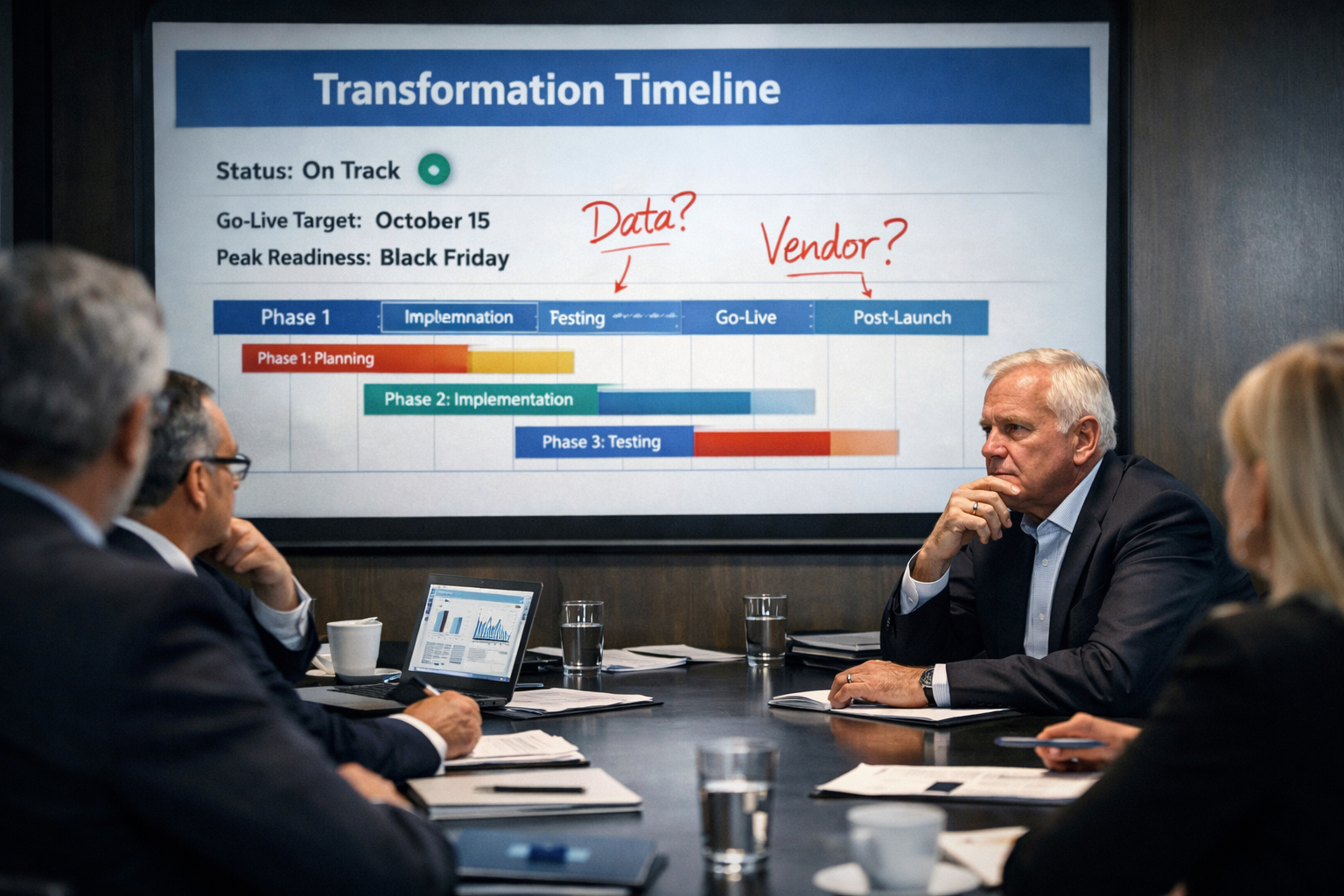
Your commerce transformation timeline slips because it is treated like a plan. It is a risk register with dates.
This article gives CEO and COO steering committees a practical accompaniment framework to keep the timeline credible: a one-page timeline risk register, a 60-minute steering agenda that surfaces trends early, and evidence checkpoints that make milestones earn trust. Less theater. More control. In commerce, the real threats are predictable: data readiness that arrives late, vendor… Read More
Written by
-
Decision principles are the real operating system of transformation
Most executive teams don’t have a speed problem. They have a coherence problem. When every function makes “fast” decisions using different rules, you don’t get agility. You get expensive chaos: conflicting priorities, rework that looks like iteration, and local wins that quietly break the enterprise. Trust erodes because the answer changes depending on who you… Read More
Written by

-
The hidden cost of speed: rework, exceptions, and decision debt
Speed feels good in the weekly readout. More tickets closed. More releases shipped. More “momentum.” Then the bill arrives. Support gets louder. Implementation stacks “temporary” exceptions. Platform becomes a queue. Product teams re-argue decisions they thought were settled. Everyone is moving, but the enterprise is not. That is decision debt: the hidden cost of speed… Read More
Written by

-
Your strategy didn’t fail. It never made it to the backlog.
If your strategy isn’t showing up as backlog items with owners, acceptance criteria, and funding, it didn’t fail; it never entered execution. For enterprise leaders who need strategy to convert into shippable work across both operations portfolios and digital product backlogs. Read More
Written by
